Wednesday June 9, 2004
THE LONG FAREWELL:
RONALD WILSON REAGAN 1911-2004
by Staff Writers
SIMI
VALLEY, Calif. - More than 115,000 cars filled with admirers
of Ronald
Reagan lined up outside the Reagan Library as an estimated 106,000
mourners filed past the former president’s flag-draped
coffin at the Simi Valley hilltop. In one of these cars Tom and
Leann Hobbs and son Quentin of Fresno had driven for hours from
the San Joaquin Valley on a trek to pay their respects to the
fallen president. Because the Santa Monica freeway and side roads
were blocked with with endless traffic jams outside Simi Valley,
the Hobbs were disappointed as were many thousands of others.
Jesse and Joni Garcia of Woodland
left their home in Northern California at 6 p.m. Monday and finally walked past
the casket at 9:45
a.m. Tuesday. “It took five hours for the last five miles of the freeway,” said
Jesse Garcia, 52. They spent two more hours in the parking lot before boarding
a bus. “It’s a lifetime event. I wanted to show my gratitude. I wanted
to show my love,” he said.
In Washington, D.C., on Wednesday,
the focus shifted to the Reagan family as they prepared to escort the former
hollywood leading man, California Governor, and President of the United States
remains on a flight to the nation's capital aboard a presidential Boeing 747.
The body,
which is scheduled to arrive at Andrews Air Force base at around 5 p.m. EST,
will then to be taken to the Capitol Rotunda to lie in state until a funeral
at the National Cathedral on Friday. It will then be returned to California for
burial at the presidential library that evening.
Reagan, the nation’s 40th
chief executive, was 93 when he died Saturday of pneumonia, as a complication
of Alzheimer’s disease. He announced he had the disease a decade ago. His
death revealed that the popularity of the former Republican president, California
governor and movie actor remained strong despite his long absence from public
life.
The public expression of sympathy
for Reagan's death began Monday after his body, accompanied by Nancy Reagan,
82, and his children, was brought 40 miles from a Santa Monica mortuary by motorcade
to the library in the Ventura County hills northwest of Los Angeles.
After a
short service, Nancy Reagan walked to the casket and placed her left cheek to
it. Her daughter, Patti Davis, hugged her tightly, and other family members joined
them around the casket.
January 12, 2004
STATE OF THE CITY ADDRESS
By Alan Aurty Mayor, City of Fresno
FRESNO -- Before
we get started, let me clear the air on a few things. First
of all,
I am honored
and humbled to have been elected
your Mayor for a second term.
There was some talk about my heart not being in this job. I can assure that
this is not the case. In fact, there is more of my heart in this job than
any other body part with the exception of my belly which, unfortunately,
enters
the second term significantly larger than the first.
Thanks for those who
voted for me. Those who didn’t, there are no hard feelings. I stated in last
year’s address that it is impossible to determine the state of our city
without first addressing the state of our state and the state of our country.
The three are inextricably connected.
This year, as in any year past or any
to come, will be no different. I also spoke of the times in which we live – one
of the most challenging eras in our history. Unfortunately, today that too
is no different. Just as World War II significantly defined the greatest generation,
the War on Terrorism will occupy a dominant space in the legacy of this generation
and, yes, the legacy of this City.
It may not be politically correct, but you
need to know where your Mayor stands. I stand in full support of President
Bush. This is a war we must win and I support our President in his steadfast
commitment to do so. Here in our state, severe budget problems, decades in
the making, have finally come crashing down, adding additional challenges to
Californians.
For California cities, the roll call is staggering – Long
Beach, $67 million deficit; L.A., $300 million deficit, San Diego, $166 million
deficit, San Francisco, $352 million deficit. But yet in the midst of this
storm, a city has emerged that has defied the pundits, confounded its critics
by meeting these challenges head-on and, in the process, earned its way to
unprecedented levels of state and national prominence.
I’m proud to tell
you today that city is the place we call home – Fresno, CA. Over the
last several years, as the success of our City became known throughout the
country, I have been asked three questions, over and over: What are you doing?
How are you doing it? Will you send me some information on that? I’m
always happy to share with them our story. Most recently, I was asked to be
the Keynote Speaker to open the 4th annual City & County Innovations Summit
in San Diego, a national organization. I was honored to represent our community
and once again tell our story to a national audience.
So how have we, as a
city, managed to move farther and faster than anytime in our history, during
one of the most difficult times in our history? Very simple, by rising up to
meet our challenges, not shrinking from them, and by understanding that the
true success of our city, or for that matter, the state of our city, cannot
be accurately measured solely by politics, policies and programs.
The true
indicator of present and future success lies in three factors that are much
more telling and much more powerful. They cannot be Fed Exed, faxed, or e-mailed
because they reside in the heart and soul of our people. I am talking about
values. In particular, three community values essential to the lasting health
of any city.
It is the same three core values that have allowed our country
to survive two world wars, the Great Depression and become the strongest superpower
the world has ever seen. The first core value is UNITY. We’ve have heard
the sayings:“ There is strength in unity”“ All for one – one
for all”“ United we stand – divided we fall”“ We
either hang together or hang apart” And we know that all of these sayings
are true no matter how many times you utter them. In 1999, I announced my decision
to run for Mayor of Fresno.
I ran on the premise that, although we had accomplished
much in our city, over the course of two plus decades a condition had developed
that, if continued to be left unaddressed, would preclude us from ever becoming
the vibrant, globally competitive city we all wanted to be. An inequity of
access to education, opportunity and quality of life had literally created
a“ Tale of Two Cities.”
I took some heat, a lot of heat, from several
corners of our community for describing our city in such a manner. Some said
I was “running down our city and running our schools down.” I
suppose some could have taken my words as an attack upon them and their particular
interest. But I think the vast majority saw it as it was truly meant to be:
as a clarion call to action. To do what our parents and grandparents did
when
faced with problems that must be solved: to acknowledge the truth regardless
of how painful a task that might be. Then come together, work together, stay
together, stay focused, stay strong and stay the course until the mission
of solving that problem is accomplished.
That call went out almost
four years ago. The voice of the skeptics and critics were in full force. (Fred at Gym-miracle) But we did come together and the voices
began to fade – we worked together and they faded even more. We have stayed
together and now these voices are being drowned out on an almost daily basis
by our community celebrating yet another victory. You know, in the movie, “A
Few Good Men,” Jack Nicholson uttered a memorable line:“ You can’t
handle the truth.”
Well, the City of Fresno has not only handled the
truth, we have dedicated ourselves, like the generation before us, to facing
that truth head-on as a united community committed to ensuring equal access
to opportunity, education, and quality of life for every Fresnan in every neighborhood.
Back in 1999 we also identified some critical issues in our city that we vowed
to bring the full force of this newly united Fresno upon. Four years later,
although there is much left to be done in each of those areas, the results
are something every hardworking Fresnan can feel proud of. Let’s take
a quick look at some of these key issues. In the area of GROWTH, we literally
had no plan four years ago.
For nearly thirty years we had succumbed to unbridled
growth to the North accompanied by an abandonment of the South, no General
Plan update since 1984 and a relationship with Clovis and the County that wouldn’t
even let us get together, much less plan together. Today, we have made significant
gains. Through newfound cooperation between the City, County and Clovis, we
have a general plan that is not only working, but is a model for the rest of
the Nation.
When we unveiled it in 2002, we were told that the plan would not
work. “People just don’t want to live in the southern section of
the City,” we were told by some. In reality, what we have seen is a 25%
increase in building permit activity since 2001. We have seen market rate housing
projects proposed for southeast and southwest Fresno. The vast majority of
growth is in southwest and southeast Fresno.
They said it couldn’t be
done. Well I’m here today to tell you that it has been done and it is
working! In addition to new market rate housing projects, the City’s
Housing Division has assisted over 1000 families with affordable housing
opportunities through our first time home buyer assistance program. It is
my commitment that
this Administration will do everything it can to keep the American Dream
of home ownership alive for every Fresnan, regardless of social condition
or position.
Thanks to collaboration between the City and Redevelopment Agency, we now
have a downtown that has been re-born, not revitalized.
The downtown skyline
has
changed dramatically and there are over 2,000 new employees in downtown Fresno
and enoughparking for all of them. We are going to see our first downtown
housing proposal – a
joint venture called Vagabond Lofts between the City, RDA, Granville Homes
and Pyramid Homes. A special thank you to the Assemi family for accepting
the challenge to build housing in downtown Fresno. I can’t tell you how
much I look forward to the groundbreaking ceremony for this historic project.
In
addition, much progress has been made on Vision 2010. The land has been cleared
for the new 5th District Court of Appeals; the two IRS Buildings have made
it through the pipeline and are now completed.
The Federal Courthouse and
Regional Medical Center expansion are nearing completion; and we are in negotiations
with Forrest City, a national developer, to develop 85 acres south of the
stadium
into a master-planned mixed-use project. At this rate, Vision 2010 may
very well be renamed Vision 2009! A very special thank you
to Dan Fitzpatrick
and Jerry Duncan for their hard work. As our City continues to expand, it is
vital
that we address the infrastructure requirements.
My recently released budget
takes the single largest step towards ending the “Tale of Two Cities” by
implementing the largest investment in City history, the “No Neighborhood
Left Behind” initiative. The plan focuses on constructing and repairing
critical infrastructure in 71 neighborhoods where little or no infrastructure
currently exists, and in some places has never existed. The project’s
total cost is budgeted at $45 million over a six-year period starting with
$10 million in ‘05. One of the wisest and most prudent investments
our City has ever made. In addition to the “No Neighborhood Left
Behind” initiative,
the citywide investment in neighborhoods will continue with over $16 million
in funding.
We have set records
every budget year on infrastructure spending. This funding will allow our Public
Works department to continue with their
work program that last year allowed
them to overlay 40 miles of City streets, install 200 ADA ramps, remove
and replace over 10,000 cubic yards of damaged sidewalks, curbs and gutters.
But infrastructure is not just about concrete and blacktop, but also about
crime
reduction
and quality of life as well. A neighborhood that has good sidewalks, curbs
and gutters will in turn give its residents a sense of pride. In many instances,
after infrastructure was replaced or repaired, we have seen homeowners
turn around and invest in their homes…a new roof, new landscaping, new windows.
The fact is, a proud neighborhood is a safer neighborhood. A neighborhood whose
residents are involved and care about each other will see reductions in crime.
See Council, I’ m learning! Thank you for the message that has been hammered
at me – you were right. I n 2003, the City of Fresno experienced
its lowest crime rate in 32 years. Through prudent management and hard
work,
the Fresno Police Department has become a
model for public safety agencies throughout the country. The department
was recently awarded first place in the 1st annual California Law Enforcement
Challenge. We know there is a rising gang problem – we are ready
to meet it and defeat it.
The
Multi-Agency Gang Enforcement Consortium (M.A.G.E.C.) consists of thirty-five
full-time officers from participating agencies. The goal of M.A.G.E.C.
is to eradicate criminal street gangs. In June and again in August of 2003,
M.A.G.E.C.
joined with other Department units and local agencies including the Fresno
County Sheriff’s Department, California Highway Patrol, California
Youth Authority, State Parole and U.S. Marshals to conduct two large scale,
pro-active
gang suppression operations. For six weeks, more than 200 officers set
out to locate and arrest violent parolees and those involved in gang
violence.
The truth is, as I’ve stated before and I’m not going
to sugarcoat it, we have seen an increase in gang activity in Fresno, as has
every other city in California. And the truth is, we will not tolerate it.
But in order to have a truly effective Public Safety policy, this zero tolerance
policy regarding street violence must also be accompanied by early intervention
with our at-risk youth. We all know that a criminal is usually created long
before his or her first crime. That’s just a fact.
The “Buddies” program
was created to provide positive adult role models for at-risk children. It
started with volunteers from the Fresno Police Department that agreed to make
a one-year commitment to spend a minimum of four hours per month mentoring
their “buddy.” It’s not like they don’t have anything
else to do in the police department - that’s how much they love this
program. It quickly expanded to local churches and service organizations
as a way of increasing community involvement.
No city our size is without
some kind of civilian oversight. It is intended to ensure the trust of
our community, a trust that the police
department
has worked so hard to build up and we can’t let perception tear it
down as we prepare to make our way through a more violent community.
The City’s Economic Development Department and EDC have also formed a
strong partnership that has contributed greatly to some significant recognition
or our job creation efforts. Most notably, Inc. Magazine recognized Fresno
as #1 in California and #4 in the Nation among medium size cities in economic
vitality for entrepreneurs. Also, Fresno was ranked 8th out of the 200 largest
cities in the Nation in short-term job growth and 2nd in the State for Metro
Area Employment Growth. Those are the facts– we are winning.
~
REPRISE ~
14 July, 1955 Beach
Storming 3rd Marine Bulldogs
Take Iwo Jima One More Time by Sgt. Howard
E. Hobbs, USMC
SOUTH
PACIFIC OCEAN -- On
14 July we embarked 40 officers and 780 enlisted on the
USS APA Class troop carrier at Yokosuka, Japan. On 14 July
at 0900 we stormed ashore carrying out Operation LEX. On
February 19, 1955 a 7th Fleet Task Force 53 that included
the 3rd Marine Division, debarked and made a landing on
the historic WWII Iwo Jima island beachead.
Iwo Jima was Japanese home soil, part of Japan, only 650 miles
from Tokyo. It was administered by the Tokyo metropolitan government. No foreign
army in Japan's 5000 year history had trod on Japanese soil. To
the US, Iwo Jima's importance lay in its location, midway between Japan and American
bomber bases in the Marianas.
Since the summer of 1944, the Japanese...MORE!
~Reprise~
April 1, 1892 JACK THE RIPPER
IDENTIFIED IN LONDON
Fresno Mornig Reupublican
FRESNO, CALIF.
--The Argus News out of London announced today that Deeming has
confessed
to the murder of his wife
and four children at Dinham villa, Rainfall,
near Liverpool, and that he has also confessed to the murder
and mutilation of the last two women whose bodies were found
in the purlieus of White Chapel.
Deeming's appearance closely tallies
with the description gievn the White Chapel fiend, Jack the Ripper,
and although he does
not admit killing the other White Chapel victims, it is believed
that when he finds all hope of escape from the clutches of the
law is cut off he will confess, not only of these murders, but
of others of which the police know nothing.
It transpires that
the unfortunate woman, whose body was found together with four children under
the floor of the Rainhill residence,
was not Deeming's first wife. Some years ago a sensation was created
in Australia by the mysterious disappearance of the wife and two children of
a man who then
went by the name of Williams, but who turned out to be Deeming.
The family then resided in Sydney. There
was grave suspicion of foul play at the time, but the bodies were not found,
and
the essential proof of the murder being lacking, the matter will
be allowed to drop. Deeming subsequently went to England and
married a woman whose murder he now confessed.
The Argus says Deeming
makes no mention of his object in mutilating the bodies of the White Chapel victims,
but adds there is scarcely
a doubt that the man is afflicted with a disease similar in some
respects to nymphomania.
March 25, 004 Internet Ruling
Puts Interior Dept. Back Online
By Robert Gehrke. Associated Press
WASHINGTON (AP) -- The Interior Department will go back online
after an appeals court Wednesday blocked a judge's ruling that
ordered most of the department's computers disconnected from the
Internet.
It took the U.S. Court of Appeals for
the District of Columbia Circuit just three hours to grant the
government's request to restore the Interior's Internet access.
It had been shut down since March 15 to protect money owed to
American Indians from computer hackers.
The shutdown disrupted public's access
to Interior Department Web pages, land managers' communications,
disbursement of mineral royalties to states, and education of
children in Bureau of Indian Affairs schools. Interior Secretary
Gale Norton said she was pleased with the appeals court decision
and will continue pushing for a permanent reversal of the Internet
shutdown. "Meanwhile, tonight we have
begun to restore our Internet connections across all impacted
agencies of the department and will work quickly to restore them
to pre-March 15 levels," she said.
[Editor's Note: Last November,
Interior flunked a security test given by a House panel. But so
did the departments of Agriculture, Commerce, Education, Justice,
Treasury, Defense, Labor and Transportation, among others. It
just so happened that Interior was already in the midst of a bitter
court case in which faulty security could play a role and DOI
was taken down.]
Saturday March 13, 2004 Polygamy, Incest
in Fresno Mass Murder
By Brian
Sokolooff, Associated Press
FRESNO, Calif. - A man
suspected of murdering nine of his family members apparently was
involved in polygamy and incest, fathering two of the victims with
his own daughters, police said Saturday.
The bodies of six females and three males,
ages 1 to 24, were found tangled in the back room of Marcus Wesson's
home Friday. Fresno's largest mass murder ever quadrupled its homicides
for the year in a single night and disturbed officers so much that
some immediately needed counseling.
Wesson, described by police as "very
calm," was arrested Friday after emerging from his home covered
in blood. Wesson, 57, has fathered children with at least four
women, two of whom are his own daughters, said Fresno Police Chief
Jerry Dyer.
Wesson, described by police as "very
calm," was arrested Friday after emerging from his home covered
in blood. Wesson, 57, has fathered children with at least four women,
two of whom are his own daughters, said Fresno Police Chief Jerry
Dyer."We are exploring the possibility that there were other
women he was involved with, either sexually or in some sort of polygamist
relationship," Dyer said.
Police said they believe all the victims
are members of Wesson's family, but they declined to release names
pending notification of kin. Wesson was cooperating with police,
who planned to charge him with nine counts of murder, Dyer said."If
this does not qualify for the death sentence, then there is no case
that would," Dyer said.
Six coroners, triple the typical weekend
staff, were working Saturday to identify the victims and determine
how they were killed, Deputy Fresno County Coroner Sarah Davis said.
Officers were originally called to the home Friday afternoon for
a child custody dispute. Inside was a discovery
so grisly reduced Dyer to tears.
The bodies were so entangled in a pile
of clothing that it took hours for investigators to reach a final
count, police said. Ten coffins lined a wall inside the home's front
room."What's making it so difficult is the bodies are not only
intertwined, but stacked on top of each other," Dyer told reporters
Friday night. Police were not sure of a motive, but Dyer said "there
may have been some type of ritual" involved.
"I've been with the Fresno Police
Department for 25 years, and I've never experienced anything of
this nature," said Dyer, who wiped his eyes Friday night as
officers carried bodies out of the home, cradling the youngest ones
in their arms.
The scene was so gruesome some of the first
officers into the house were placed on administrative leave and
received counseling Friday night. Six police chaplains were at the
house throughout the evening as detectives continued to gather evidence.
Officers were called to the home Friday afternoon by two women who
said a man had their children and would not release them.
The man initially ignored orders to come
out, running into a back bedroom as two other women fled the house.
They were unharmed. A neighbor, Chris Tognazzini, said he heard
two gunshots moments before police arrived.yer said the women who
called authorities told them they had given custody of their children
to Wesson two years ago and now wanted them back
The slayings shocked authorities in Fresno, a
city of 440,000 about 190 miles southeast of San Francisco. Dyer
said the city had seen three murders in the last 2 1/2 months, the
fewest number for a 10-week period in more than three decades.the
nine deaths represent the largest mass killing ever in this San
Joaquin Valley city. Seven people were killed in rural Fresno in
1993
.Another neighbor, Johnny Rios, said that
on many nights he heard loud banging coming from the house, as though
the people inside were building something. "There was something
up over there," Rios said.
~Reprise~
September 23, 1958 The Twisted Cross Alive &
Well
at Fresno State College
by Howard E. Hobbs, Editor & Publisher
Fresno Republican Newspaper
[Contains 1,678 words]
FRESNO STATE
-- Prior to the recent wave of popular discussions on the behavior
of 'ordinary Germans' under Nazism, this writer has been attempting
to focus public and scholarly attention on the life of Fresno State
German Language instructor who, while posing as as an American "foreign
student" actually was a paid radio broadcast propagandist for
the Third Reich in Berlin between 1933 and 1939.
Karl Leonard Falk, one of the most
extraordinary figures in the history of Fresno State College carried
into his work in Fresno California many of the Nazi values and traditions
he personified while working for the Third Reich in Nazi Berlin
as a young man. Falk worked directly under Goebbels, Hitler's Reichs
Minister for Propaganda and Re-Education. While in Hitler's employ,
Falk wrote a series of propaganda tracts widely disseminate in Czechoslovakia's
sudetenland. Falk even managed to draft an anti-American work of
over 100 pages which was published by Hitler as a Berlin University
text-book on the evils of American newspaper journalism.
Moreover, as a well-known author of numerous
anti-semitic tracts, he had been pondering for a long time the problems
of the Jewish controlled news media in Germany. Falk weaves his
own views into his 'history of the basic problems with American
newspapers' interlacing them with sometimes heavily pedagogical
explications on the nature and pitfalls of greed, monopoly, and
the 'appetites' of American newspaper readers.
Berlin was at that time the preeminent urban
renewal site in the entire world. Germany through the late thirties
was under continuous rebuilding. Berlin, with its position at the
center of state and Party architectural policy, experienced Hitler's
redesign of the capital and its centralization under the direction
of Albert Speer who was given authority to control architectural
policy as Inspector General of Building for the Reich Capital in
Berlin (Generalbauinspektor fur die Reichshauptstadt Berlin).
Because of the scale of the urban plan,
quarries and contractors, architects and bricklayers were all mobilized
by Speer's offices, making his proposals the largest single architectural
project in the German building economy. The actual plan, included
a north-south and east-west axis at the heart of the City, a concentration
of subway and train facilities, a redesign of the Konigsplatz, and
a major housing program.
The north-south axis became the core of
the urban design and was meant to function as the main ceremonial
boulevard of the new Aryan Berlin. p>The few art historians who
have analyzed National Socialist art and architecture have consistently
turned to Speer's redesign of Berlin as paradigmatic of the overblown
schemes of the Party to project its ideological goals through visual
form, to create literally the "word in stone." Scholars
have most often emphasized three key components of the Berlin redesign:
the massive scale of the plan, the iconography of neoclassical forms,
and the choice of materials, above all stone.
Alex Scobie, for example, has argued that
the scale, materials, and iconography of prestige projects in Berlin
were used by Nazi architects and critics to promote an ideological
connection to classical political and social institutions. Even
Speer, in his Inside The Third Reich memoirs, confirms the
following parameters: The Fuehrer style widely claimed by
the Nazi Party press was neoclassicism multiplied, altered, exaggerated,
and often presented through a distorted point of view. Hitler thought
he had found certain graphical relationship between the Dorians
and his own Germanic world. Size, the indestructible
nature of stone architecture, and the iconography of neoclassicism
were all at play in Speer's extreme ideological mystifications.
When considered in terms of anti-Semitism,
this scholarly concern with architectural form in general, and with
the urban planning of Berlin in particular, has led to an investigation
of the specific Party and state institutions that used architectural
communication to reinforce a connection to a specious racial history
or some supposed essence of German Arayaness.
The destruction of the European Jews has
been amply linked to pseudo-scientific Nazi racial theories as such
propaganda was reinforced by art and architectural expression in
a brutal connection between architectural history and anti-Semitism.
This writer sees the connection between
Karl Leonard Falk's oppression of the Jews initially characterized
by slurs and stereotypes that were supported by incessant fallacious
racial propaganda spewing out of the Propaganda Ministry and the
psychological function of Speer's architectural goals that were
integrated into the creation and implementation of state policy
against the Berlin Jews. But this propaganda
set-stage was quickly stage-managed with brutal tactics that concentrated
the Jewish community in Berlin and eventually led to mass deportation
and mass murder.
To grasp how the work of Karl Leonard Falk
played a key role in the decisions made concerning a Nazi policy
of extermination of the Jews requires recognition that the formal
design of a monumental urban plan for Berlin functioned as piece
of the puzzle for developing a final solution through a
systematic anti-Semitic policy. To understand this connection it
is important to concentrate attention on the implementation of particular
economic and social policies aimed at the Berlin Jewish population
during the years 1933-1938.
Specifically, anti-Semitic housing policy
(concerned as it was with controlling and then removing the Jewish
population) became a focus of key efforts made by Propaganda Ministry
tracts, films, and radio broadcasts, and by Speer to complete the
monumental plans for the rebuilding of Berlin by 1938.
Since the rapid industrialization of Berlin
in the late nineteenth century, housing had been a perennial problem
and concern of the city's building administration and a factor in
every major site plan for monumental architectural projects. A lack
of suitable housing reached crisis proportions with Speer's attempt
to impose a massive urban design on a city that already suffered
from an insufficient number of dwellings for the ever-growing industrial
working population. Within the context of the housing debate, Speer
even interested himself in particular modernist solutions, such
as mass-produced prefab housing units.
It is important to remember the clear historical
connection between housing policies in reference to the political
uses to which urban planning was put in Berlin urban renewal during
this period. While the political function of architecture has been
a major focus of a critical discussion of urban planning in Berlin
not widely recognized today. Speer's role in implementing policies
against the Jews in Berlin was apparent from the Third Reich's systematic
anti-Semitic housing policy and systematic development of architectural
interests and the oppression of the Berlin Jews.
For example, documentary evidence indicates
that Speer not only implemented but also attempted to formulate
an anti-Semitic policy to serve his architectural interests. If
Hitler's ideas on urbanization are shockingly like those which were
expressed by Karl Leonard Falk in the 1950's in Fresno, California.
Falk, by that time had been appointed to
head the Fresno Housing Authority, a key political position at Fresno
City Hall. Like Hitler and Speer before him, Falk's vision for a
new Fresno was not a vision Fresno as a center of a rich and growing
cultural and socioeconomic diversity but as a site of political
power. Falk's architectural plan for urban redevelopment of Fresno
concentrated on the downtown area adjacent to the hall of its political
power.
Downtown Fresno, for Karl leonard Falk would be
transformed into a base for gigantic government housed in monumental
public buildings surrounded by jails and prison buildings, amid
a huge public mall, wide expansive walkways, public art, and the
absence of evidence of private property. Such were the symbols of
Falk's dream of gaining political power through a piecemeal approach
that would eventually overwhelm and subdue Fresno's citizens through
wide ranging exercise of City Hall's police powers, and wide ranging
use of condemnation powers to rid the core of the City of its homes,
apartment houses, and small businesses.
Falk's vision of societal utopia was not
one that saw the democratic participation of free citizens and the
trading of ideas in the political marketplace, but of the exercise
of tyranny of the minority over the majority. It is true that Falk
wanted to create an American-style Third Reich. That fact
is subtly illustrated in his refusal to buy-American because of
his fanatic devotion to Hitler's a mass-produced people's car
the Volkswagen, the only car Karl Leonard Falk would own.
Karl Leonard Falk, then, was at heart,
an urban planner and a modernizer who dreamed of creating a consumer
society in Fresno, California exclusively for Aryans, like
himself, based on conquest by urban renewal funds and block grants
from Washington D.C., the darker side of Fresno City Hall and the
U.S. Congress between the years 1938-1971. Those were the years
of Karl Leonard Falk's New Reich , and of course made possible
by his academic tenure and Presidency at Fresno State College.
Falk cherished his collection of German
newspaper anti-Jewish propaganda and pornography in Julius Streicher's
smutty German newspaper, Der Sturmer. A representative portion
of Karl Leonard Falk's anti-Jewish smut predilection, even prior
to his experiences inside Berlin, is available for viewing at the
Fresno State University Madden Library, Special Collections, in
Karl
Falk Collection of German Notgeld.
The Karl Falk desiderata includes facsimiles
of two front pages of Der Sturmer, from the early 1930's.
Incidentally, Julius Streicher's work was described in The Life
and Death of Adolf Hitler as 'remarkable for those qualities
of brutality and bestiality ... in which the Jews were always depicted
as sub-human monsters and perverts.' [Robert Payne,
The Life & Death of Adolf Hitler, pages 167-168. Praeger Pub. Co.,
New York, 1973.]
Incidentally, Streicher was captured by
U.S. Military at the end of the war and held to answer for his war
crimes. He entered a not guilty plea and was subsequently
convicted of treason by his taking part in psychological warfare
against the United States.
Falk escaped prosecution as a war criminal
by returning to the U.S. and taking a foreign language teacher job
from a Fresno State College president who found Falk eminently qualified
to teach undergraduate courses on the German language and Nazi culture.When
Fresno State was being considered for University status, Falk's
1939 Technische University of Berlin doctorate. was upgraded
by the University of California and Professor Karl Leonard Falk
was suddenly transfigured into Fresno State University Social Science
department chair status. Transcripts on file with the State of California,
however, lacked any record of Falk having enrolled in, much less
any completed coursework from any accredited university in Social
Science disciplines.
Thursday February 26, 2004 On A Clear Day
See How Far He Runs? by Howard E. Hobbs
PhD, Editor & Publisher
FRESNO
-- In a recent meeting of Alexander Hamilton School
parents, Fresno Mayor Carlos Alan Autry was asked to address three
specific public concerns about the involvement of Fresno City
Hall staff in the launching of a $250,000 newspaper venture called
The
New Valley Times. The Mayor quickly adopted the "duck
and cover" approach and shined-on all questioners.
He has called for a fresh approach at
City Hall. It is apparent that city residents want knowledgeable
leadership and direction, not politics as usual. Leadership requires
the courage to Make decisions that will benefit the next generation.
He has promised that kind of leadership.
But talk is cheap. He made statements like, "You don’t
need a city charter to know that education is the foundation of
any community." And, he said he "believes in the tremendous
power in the truth and "fiscal responsibility ensuring that
every taxpayer’s dollar is accounted for and used appropriately
and judiciously for essential City services." When asked
"The New Valley Times - is that the vision for Fresno? His
answer was.MORE!
Monday, January 26, 2004 Is Mock Journalism
Protected Speech
By John Council,
Contributor
FRESNO -- The Texas Supreme Court heard
a lively debate recently in a case of first impression that may
determine whether satire is a protected form of speech.
At issue is "Stop the Madness,"
a 1999 article printed in the Dallas Observer. The article is a
mock story with made-up quotations attributed to public officials
including District Attorney Bruce Isaacks and Court-at-Law Judge
Darlene Whitten of Denton County, Texas, according to lawyers for
the newspaper.
The article was so outrageous that the
average reader could not have taken it seriously, the lawyers assert.
But Mike Whitten, a lawyer for Isaacks and Darlene Whitten, alleges
that some readers did believe the article was true, making it libelous.
(The Whittens are husband and wife.)
The article, over which a box with the
word "News" in it was placed, concerned the arrest of
fictional 6-year-old Cindy Bradley for writing a book report on
Maurice Sendak's children's book "Where the Wild Things Are."
According to depositions in the case, the
genesis of the article was an actual October 1999 incident in which
Darlene Whitten ordered the detention of a 13-year-old who allegedly
wrote an essay with a violent tone and turned it in at school.
Isaacks and Darlene Whitten sued the Dallas
Observer and its parent company, alleging libel in New Times Inc.
v. Isaacks, after the alternative weekly newspaper refused a request
by the officials to publish a retraction of the article. A trial
court and the state 2nd Court of Appeals refused the Dallas Observer's
summary judgment motion, which the newspaper then appealed to Texas
Supreme Court.
Lawyers for the Dallas Observer argued on
Dec. 3 that the article was a form of free speech protected by the
First Amendment."The ultimate message that the Dallas Observer
was trying to convey was that the actions the officials made were
misguided," argued Jim Hemphill, a partner in Austin's George
& Donaldson who represents the Dallas Observer. "That is
an opinion. And that is protected."
But Mike Whitten, a partner in Denton's
Whitten Law Firm, argued that the Dallas Observer went too far because
numerous readers allegedly believed the article was true. Whitten
said both of his clients received nasty comments from people who
were outraged by it.
" I think if you publish a false statement
of fact about someone and it's believed by a reader, then that's
libelous whether you label it satire or it's in the driest journal,"
Mike Whitten argued.
The fictional article contained fictional
quotes from Whitten saying: "Any implication of violence in
a school situation, even if it was just contained in a first-grader's
book report, is reason enough for panic and overreaction."
The fictional article quotes Isaacks as
saying: "We've considered having her certified to stand trial
as an adult, but even in Texas there are some limits." And
the fictional 6-year-old Bradley was quoted saying: "It's bad
enough people think like [J.D.] Salinger and [Mark] Twain are dangerous,
but Sendak? Give me a break, for Christ's sake. Excuse my French."
Some of the justices questioned Mike Whitten
how anyone could believe the article was true based on those quotes.
" How many 6-year-olds do you know
that are familiar with Salinger?" asked Justice Scott Brister,
the court's newest member, who was appointed by Governor Rick Perry
in November. " Not too many," Mike Whitten replied. "I
don't know how many readers know Salinger."
Also central in the justices' questioning
was the application of New York Times v. Sullivan to the Dallas
Observer article. That seminal 1964 U.S. Supreme Court ruling found
that to win libel cases, public officials must establish "actual
malice" to prove that a publication knew its article was false
or published a story with reckless disregard for whether it was
true or false.
Tuesday, January 27, 2004
George Bush
State of the Union
By I. M.Wright, Contributor
FRESNO -- On Tuesday, President
Bush delivered his State of the Union address. Contrary to the popular
view, the Constitution does not require this annual exercise. Article
II only directs the president "from time to time" to give
"information on the State of the Union" to Congress.
The framers intended the president to assist
Congress in performing its legislative duties. In modern times,
however, that assistance has given way to usurpation, as Congress
routinely abandons its legislative powers, leaving a quasi-imperial
presidency (aided by a number of extra-constitutional regulatory
agencies) to exercise the Nation's sovereign power. It's hard to
imagine one man would be up to such a task. George W. Bush certainly
was not on Tuesday.
The president built his address around
the consistent theme of his presidency: "compassionate conservatism."
The exact meaning of his philosophy has always been elusive, but
Tuesday's speech provided a good roadmap for the novice traveler.
In short, compassionate describes the president's
metaphysics and epistemology, and conservatism summarizes his ethics
and politics. On all four counts, compassionate conservatism is
a philosophy repugnant to the values embodied in the American constitution
and the Declaration of Independence.
Metaphysics establishes the nature of existence.
It is rooted in the law of identity—A is A, as Aristotelians
would say.
Metaphysics establishes what is, while
epistemology determines how a consciousness can acquire and use
knowledge of its existence. This sounds like weighty stuff, but
it's important to understand the foundation of any philosophical
system.
In George Bush's philosophy, he views existence
as ultimately unknowable; he accepts, without evidence, the existence
of God and a realm beyond the comprehension of man's consciousness.
This metaphysical view determines Bush's epistemology, since he
rejects reason as the sole means of acquiring knowledge. Instead,
Bush considers reason and faith to be equally valid methods of cognition.
Compassion is Bush's shorthand for acquiring
knowledge via faith and emotion. The president believes that man's
understanding of the universe comes from compassion, which is his
emotional acceptance of other peoples'—and God's—perceptions
of reality. By this standard, Bush finds truth in the compassionate
acts of man towards man. Ultimately, he believes, God reveals himself
through such acts, and this makes true knowledge of existence knowable
to man on some level.
This theory of knowledge allows Bush to
accept contradictory premises. The best example from his address
came when he talked about the prospects for democracy in the Middle
East: "We also hear doubts that democracy is a realistic goal
for the greater Middle East, where freedom is rare.
Yet it is mistaken, and condescending,
to assume that whole cultures and great religions are incompatible
with liberty and self-government. I believe that God has planted
in every heart the desire to live in freedom. And even when that
desire is crushed by tyranny for decades, it will rise again."
Bush assumes, on faith, that man instinctively
possesses the knowledge to "live in freedom". But history
tells us otherwise. Freedom, liberty, and individual rights are
social concepts that took centuries to develop. The United States
first brought these concepts into a unified republic. But there
was nothing automatic or religious about this accomplishment. And
Contrary to the president's statement, these
concepts are incompatible with many cultures and religions. If they
were compatible, why then haven't individual rights republics sprung
up throughout the Middle East? Indeed, why haven't they sprung up
in Asia or Africa? But since Bush believes they are compatible,
all evidence to the contrary, then it must be true, for faith makes
it so. On matters of ethics and politics, Bush's compassion
melds with conservatism. This means the president views rights as
derived not from man's existence, but rather from institutions invested
with compassionate or mystical authority.
Bush referred to rights just once in his
speech, saying America's foreign policy sought a "peace founded
upon the dignity and rights of every man and woman". But the
rights he spoke of were not those derived from man's nature, but
from man's creator, or God.
All rights, in the president's view, exist
only by permission of established authorities. Or to use a more
conventional conservative premise, order takes precedence over liberty.
In the section of Bush's speech on morals,
the president points to four specific problems: illegal drugs in
schools, performance enhancing drugs in sports, teenage sexuality,
and gay marriage. On each issue, the president relies first, foremost,
and finally on the ethical principle of "duty." Consistent
with a compassion-based epistemology, all men must judge their actions
by the emotional needs of others.
Students must submit to forced drug testing,
not because it's in their self-interest or respects their rights
as individuals, but because the president says "we love you,
and we don't want to lose you". The children must think of
the emotional needs of their parents. Similarly, athletes must stop
using drugs, not because it harms them, but because they must be
"good examples" for the children.
On issues of sexuality, the president's
compassion meets his fear and bigotry. He calls for doubling "federal
funding for abstinence programs" so that students can learn
to fear their sexuality as they fear drugs. The very concept of
the government directing the education of children about sex—the
most important, intimate, and value-based of all human actions—is
appalling. If the president believes schools may forcibly test students
for drug use, would he also be open to testing students to preserve
their virginity? It may sound far-fetched, but once the government
claims ownership of the mind and the body, I have difficulty ascertaining
the limits of that authority.
And then there's gay marriage. This section
of the speech may have been the most morally repugnant. The president
openly coddled the bigotry of those Americans who would deny homosexuals
their right to form and raise families on equal footing with other
Americans. Bush pledged to "defend the sanctity of marriage,"
as if it were something other than a man-made institution. The president
couldn't bring himself to acknowledge the existence of homosexuals,
much less respect their rights. Instead, he offered this moral gem:
"The same moral tradition that defines marriage also teaches
that each individual has dignity and value in God's sight".
Notice he didn't say individuals have "rights", only dignity
and value.
The moral tradition Bush cites—Judeo-Christian
morality—has not had a good track record through the centuries.
Indeed, this tradition was invoked in support of the Dark Ages,
the Inquisition, the Salem witch trials, slavery, the American civil
war, segregation, and now homophobia. From an objective moral view,
there is no difference between Bush's defense of gay marriage's
bigoted opponents and George Wallace standing in the doorway at
the University of Alabama in defense of the "moral tradition"
of segregation.
Finally, we come to Bush's politics, the
outgrowth of his conservative ethics. Since Bush relies on "moral
tradition" to define his ethics, it's logical that he relies
on institutions—rather than man and his nature—to define
and implement the scope of man's rights. This is why you'll never
hear this president call for the abolition of any government department
or major program; his conservatism requires institutions be treated
with delicate care bordering on reverence.
Consider the president's position on healthcare.
His only veto threat of the night came when he vowed to stop "and
any attempt to limit the choices of our seniors, or to take away
their prescription drug coverage under Medicare". In other
words, seniors have a right to prescription drug coverage because
the institution of Medicare gives it to them. Now Bush's defenders
will argue the administration spearheaded Medicare reforms, notably
a limited health savings account program. This is a potentially
useful reform, I'll grant you. But it does not mitigate the president
using a government program to create a new "right" that
exceeds the government's constitutional power.
And while the president said a "government-run
health care system is the wrong prescription," these words
rang hollow. We already have a government-run health care system.
Unlike the systems in Canada or Europe, however, the American government
relies on quasi-private managed care companies to ration health
care. Managed care firms receive government subsidies and special
legal protections, and they charge prices consistent with the government's
Medicare rates. Yet despite this, Bush shows no signs of seeking
to undo this system. If anything, his healthcare policy requires
strengthening managed care, something that will only prevent the
free market from taking hold.
The other major institution Bush reveres
is public education. He reveres it so much, he bragged about a 36%
increase in the federal budget for education. And he won't stop
there. Bush asked for expanded aid to colleges and students. He
claims this will train workers for better jobs. The fact that individuals
already can receive this training without extra tax dollars is lost
on the president. Bush does not judge ideas on its rational merits,
but on the level of "compassion" it causes him to experience.
Certainly helping people attend college is charitable, but when
that charity comes at the expense of innocent taxpayers, it is also
robbery.
Bush's education policy demonstrates a
complete misunderstanding of education, which is not surprising
given his non-reason-based epistemology. In one passage, he makes
a tautological argument: "Some want to undermine the No Child
Left Behind Act by weakening standards and accountability. Yet the
results we require are really a matter of common sense: We expect
third graders to read and do math at third grade level - and that
is not asking too much. Testing is the only way to identify and
help students who are falling behind."
When I was in third grade, I read and performed
math at what New York State considered a seventh-grade level. But
I was not allowed to leave third grade early, and in other states,
my proficiency would have been fixed at different levels. The point
is, grade levels are a construction of the government-run school
system. They have nothing to do with education. Individual students
learn according to their own abilities and opportunities. But government
schools focus on the collective at the individual's expense. Many
parents have long recognized this fact, and either educates their
children at home or place them in a private school more conducive
to their child's learning style (such as the Montessori Method).
American healthcare and education suffer
from the same political-economic design flaw: the free market in
both has been replaced by a government-directed rationing scheme.
Consumers are generally not free to purchase their own healthcare
and education without working through the rationing scheme; even
if they can, they're still required to pay taxes to support the
schemes. Bush never addresses this basic problem, because to do
so would force him to renounce the underlying institutions, something
his conservatism (and his compassion-based epistemology) won't allow
him to do.
At the end of the day, we are left not
with the bold, visionary leader that some conservatives believe
George Bush to be. We are left with a small man promoting small
ideas. Bush may talk the rhetoric of a pro-capitalist, pro-individual
rights leader, but his actions are that of a man who sees the role
of government as that of a grand charity, where acts are judged
by compassion rather than reason and merit.
But charity is not a moral basis for government;
charity is a byproduct of a successful society that produces a surplus
of wealth that be shared according to the values of its producers.
Unless the government is built on an unimpeachable foundation of
reason, individual rights, and capitalism, true charity is not possible;
what you have instead is "compassionate conservatism",
a philosophy that promotes emotional, intellectual, and political
stagnation.
Monday, January 26, 2004
McClatchy to Publish
Fresno State's Mock
Journalism News
By Howard Hobbs PhD, Editor & Publisher
FRESNO -- According to
the Fresno Bee Newspaper, today's early edition describes a brighter
future for Fresno by 2015 which is depicted as having 3% unemployment,
clean air, a downtown lake surrounded by fine restaurants and upscale
homes, a monorail and top-notch schools. Bee editors see one hitch,
however. "The only hurdle: the community itself." To overcome
public resistance, however, McClatchy, the publisher of the Fresno
Bee has a plan.
The thinking goes somewhat along this line,
a quote from Pablo Lopez, in today's Fresno Bee "Local &
State" business pages - "Mock newspaper sees bright future
for Fresno... in 2015..." and discusses a mythic "New
Valley Times" newspage which might or might not be distributed
as another Fresno Bee pull-out for home-delivery and news rack availability.
What suddenly brought this on? It's origins seem
lost in the tule fog some where back in a 1998 brainstorming session
among Fresno State students in a "government" class in
which a curricula covering other myths like affordable housing,
zoos, parks, a new university plan focusing proximity to the ski
slopes and sandy coastal beaches were the center focus of discussion.
Enter, Fresno State President John Welty
and Ken Newby, president of the Fresno Business Council who will
now step forward in the glare of another public news spectacle today
and announce the launch of yet another university mission impossible. Already
being quoted in the Fresno Bee prior to Dr. Welty's scheduled news
conference later in the day, "It's important for Fresno's future
to get as many people working on the changes that are needed,"
Welty said. "The newspaper will get people thinking about what's
possible by 2015... Fresno State is taking a leadership role because
it has the resources -- professors, lecturers, students, staff and
libraries -- and a public institution's duty to improve the
region in which it is located."
Ashley Swearengin, chief executive officer
of newspaper project and executive director of Fresno State's Office
of Community and Economic Development, is already loaded up with
job duties in the Regional Jobs Institute, trying to create 30,000
real jobs in five years or less. Now she has a theoretical 24-page
"New Valley Times" publication to get out on timely basis.
The vision to accomplish this is getting blurred, however. First
off, how to get hundreds of people to work for nothing as unpaid
and non-insured volunteers.
Then, of course, someone has to proof-read
the sources of the stories, proof-reading, and fact-checking, data
entry, type-setting for real-time and Internet communications, and
so forth. If this, as yet, nonexistent newspage will be distributed
to local schools, then composing, printing and distributing the
mock newspaper presents insurmountable fiscal and accounting regimens
not presently faced by local school officials. Ashley Swearengin,
by the way, while the executive director of Fresno State's Office
of Community and Economic Development, she told reporters today
that she will continue in her present job responsibilities at Fresno
State and as chief operating officer of the Regional Jobs Institute.
Thursday January 22, 2004
Indian Gaming
Measures on Ballot?
By Caroline Woon
Cal Daily Bruin Contributor
FRESNO -- Two years after
overwhelmingly passing Proposition 5, the Indian Self-Reliance
Initiative, voters will once again be asked to give gaming
on tribal lands their stamp of approval this March.
Proposition 1A would allow for the opening
of two casinos on each of the 107 Indian reservations in California
and authorize the negotiation of gambling compacts with federally
recognized tribes. Another proposition on the ballot would affirm
a compact tribes made with the state government in 1998.
"Proposition 1A is a constitutional
amendment that will make clear, once and for all, that Indian gaming
is legal," said Waltona Manion, communications director of
the Yes on 1A Californians for Indian Self-Reliance coalition.
Although the original version of this measure
passed by nearly a 2-to-1 margin in 1998, its provisions violated
the state constitution, which strictly forbids certain types of
casino games.
A lawsuit filed by Nevada casinos resulted
in the California Supreme Court overturning Proposition 5 last August.
Proposition 1A, however, would remove a century-old ban on the operation
of slot machines, and banking and percentage card games such as
blackjack.
This possibility has raised concerns among
certain groups which believe that legalized gambling will have a
negative impact on the state, both socially and economically.
"Prop 1A is bad for everyone involved,
including Native Americans," said Leo McElroy, campaign coordinator
for the Stop 1A-No Casinos coalition. "Our main issue
with it is the massive expansion in gambling and the problems that
it causes," he said. "We are really on the way to becoming
'Nevada West.'"
The measure would in fact up the number
of casinos allowed in California from 41 to 214, while nearly tripling
the number of slot machines. It would also lower the minimum age
for gambling to 18.
"I have societal objections to 1A,"
McElroy said. "It will be giving false hopes to people who
think that if they sit at the table long enough, they'll get rich.
And the billions of dollars that go into (building) these casinos
will come right out of California's economy."
Advocates of 1A said tribal gaming promotes
American Indian self-reliance by providing jobs and funding for
education, housing and health care. "It's all about Indian
economic survival," Manion said. "Because of gaming, the
Sycuan tribe in San Diego can now offer badly needed services such
as a health clinic, fire station, preschool and a library."
According to Manion, approximately
two-thirds of American Indian employment opportunities are created
by tribal gaming. "Indian lands are located in remote areas,
with no infrastructure, and no available labor pool," she said. "Gaming
has been the most effective economic development tool that tribes
have had in 200 years. It has literally removed entire communities
off of welfare."
Even if passed, opponents say that a court
challenge to Proposition 1A is inevitable, since it violates the
constitution's "equal treatment clause," which guarantees
that "a citizen or class of citizens may not be granted privileges
and immunities not granted on the same terms to all citizens."
But in 1987, the U.S. Supreme Court ruled that Indian tribes are
sovereign entities and have the right to offer high-stakes gaming.
This decision was reaffirmed by Congress the following year.
A competing measure that also addresses
the issue of gambling on tribal lands is Proposition 29. Its approval
would lead to the enactment of a different set of tribal-state compacts
negotiated in 1998, but only in the event that Proposition 1A is
rejected."Tribes were forced to sign these compacts under the
threat of U.S. attorneys stepping in and closing them down,"
said Sal Russo of Russo, Marsh & Raper, a public affairs and
political consulting firm. "A compact should be a good faith
negotiation. From the perspective of Indian sovereignty, the compacts
of 1A are a better product in the sense that there is agreement,
there is a willingness," he added.
Proposition 29 also contains far more restrictive
provisions, limiting the total number of slot machines to less than
half of what Proposition 1A would allow. This set of compacts provides
control for local citizens over casino locations, guarantee workers'
rights and regulate licensing procedures. Not a single Indian tribe
in California has pledged its support for Proposition 29.
January 16, 2004 Casino Towns Linked
to Higher Crime Rate
By Lee Shearer
Staff Writer
FRESNO STATE -- Communities
with casino gambling have higher crime rates than communities that
don't have casinos, according to researchers at the universities
of Georgia and Illinois.
There was no increase in murder rates, said UGA
economics professor David Mustard, who co-authored the as-yet unpublished
paper with economist Earl L. Grinols of the University of Illinois
and Illinois graduate student Cynthia Hunt Dilley.
But six other felony crimes did increase,
Mustard said: aggravated assault, rape, burglary, auto theft, larceny
and forcible robbery. Auto theft showed the sharpest increase --
30 percent higher in counties with casinos -- followed by robbery,
at 20 percent, according to the study.
Overall, casinos push up the crime rate
by nearly 8 percent, the study concludes. The researchers timed
the release of their study to coincide with the final report of
the National Gambling Impact Study Commission, which is expected
today to propose steps to halt the spread of gambling.
The higher crime rates don't show up right
away, but tended to appear in the third year after a casino opened
-- perhaps because it takes chronic gamblers that long to exhaust
their resources, Grinols suggested. About 2 percent to 5 percent
of the gamblers in casino areas can be classified as ''pathological''
or ''problem'' gamblers, according to Grinols.
Earlier studies have shown conflicting results
-- that crime stayed the same, increased or even decreased after
casinos come in, Mustard said, and some experts have even argued
that casinos cause crime to go down because they increase employment
in an area.
But those studies were limited by a small
time frame or a small area of geographical study, he said. ''What
makes our study unique is that it's the most exhaustive study on
the subject,'' Mustard said.
The researchers included census data from
every county in the United States and looked at crime data over
a 20-year period beginning in 1977. They also introduced statistical
control factors to account for 50 variables that might affect crime
rates, including things like the age of the population in the area,
income levels, race and population growth.
Nationally, crime rates have been steadily
decreasing in the 1990s after steady increases in the 1970s and
1980s. The number of counties with casinos has increased from 14
in 1977, all in Nevada, to 167 in 1996.
According to the national gambling commission,
total legal wagers have grown to about $600 billion a year in the
United States -- more than is spent by Americans on cars or groceries.
And the poor bet more, according to the commission.
According to the commission report, gamblers
with household incomes $10,000 a year wager three times more money
than those with household incomes exceeding $50,000 a year.
Nationally, casino revenues were $26.3 billion
in 1997, the commission says. But the increased crime came at a
cost of some $12.1 billion annually -- about $63 for every adult
American, according to the researchers.
The point, said Mustard, is that ''What
you want to do is evaluate the costs and benefits of the casinos.
Crime is one of the costs, and you want to look at all the costs
and all the benefits,'' he said. Mustard pointed out that the study
was unfunded -- that the researchers took no money from either pro-
or anti-gambling sources.
[Editor's Note: Go to Yosemite
News for latest local area casino up-dates. And for pro-con
positions see Casino
Economics.]
January 7, 2004 Legislative Analysis
Measures Requiring Reimbursement The Leglistative Analyust Offfice 925
L Street, Suite 1000, Sacramento, CA
SACRAMENTO -- In 2002 and
2003, the Commission on State Mandates determined that 23 sets of
state laws impose state reimbursable mandates on local governments.
The commission estimated the state's cost to reimburse local agencies
for these mandates is about $400million.
This report reviews the newly identified
mandates, and offers recommendations as to whether each mandate
should be repealed, funded, suspended, or modified. This report,
submitted in fulfillment of Chapter 1123, Statutes of 2002 (AB 3000,
Budget Committee), reviews 23 sets of state requirements that the
Commission on State Mandates (CSM) identified as state-reimbursable
"mandates" in their 2002 and 2003 reports to the Legislature.
These newly identified mandates are in addition to over 100 ongoing
state requirements that the CSM (or its predecessor agency) previously
determined to be state-reimbursable mandates.
The Legislature's intent in requiring the
Legislative Analyst's Office (LAO) to prepare an annual analysis
of newly identified mandates was to ensure that it had information
regarding each new mandate at the time the Legislature considered
the annual mandate "claims bill." Pursuant to Government
Code Section 17612, the claims bill (1) usually provides the initial
state reimbursement for newly identified mandates and (2) gives
the Legislature some opportunity to review commission actions. After
a mandate receives its initial reimbursement through the claims
bill, the Legislature traditionally funds a mandate's ongoing costs
in the annual state budget.
Given the mounting costs of state mandates,
the Assembly held hearings to review mandates and the mandate reimbursement
process. Because of the state's fiscal difficulties, however, the
Legislature did not introduce a claims bill to reimburse local agencies
for newly identified mandates -- provided no funding for ongoing
mandates in the 2003-04 budget -- declared its intent in Chapter
228, Statutes of 2003 (AB 1756, Budget Committee), to continue deferring
mandate reimbursements through 2004-05 -- acted to reduce local
agency mandate responsibilities and associated state liabilities
by suspending local agency requirements to implement 39 mandates
in 2003-04, including eight newly identified mandates.
This report, submitted in fulfillment of
Statutes of 2002 (AB 3000, Budget Committee), reviews 23 sets of
state requirements that the Commission on State Mandates (CSM) identified
as state-reimbursable "mandates" in their 2002 and 2003 reports
to the Legislature. These newly identified mandates are in addition
to over 100 ongoing state requirements that the CSM (or its predecessor
agency) previously determined to be state-reimbursable mandates.
The Legislature's intent in requiring the
Legislative Analyst's Office (LAO) to prepare an annual analysis
of newly identified mandates was to ensure that it had information
regarding each new mandate at the time the Legislature considered
the annual mandate "claims bill." Pursuant to Government Code Section
17612, the claims bill (1) usually provides the initial state
reimbursement for newly identified mandates and (2) gives the
Legislature some opportunity to review commission actions. After
a mandate receives its initial reimbursement through the claims
bill, the Legislature traditionally funds a mandate's ongoing costs
in the annual state budget.
Given the mounting costs of state mandates,
the Assembly held hearings to review mandates and the mandate reimbursement
process. Because of the state's fiscal difficulties, however, the
Legislature:
Did not introduce a claims bill to reimburse local agencies
for newly identified mandates.
Provided no funding for ongoing mandates in the 2003-04 budget.
Declared its intent in Chapter 228, Statutes of 2003
(AB 1756, Budget Committee), to continue deferring mandate reimbursements
through 2004-05.
Acted to reduce local agency mandate responsibilities and
associated state liabilities by suspending local agency requirements
to implement 39 mandates in 2003-04, including eight newly identified
mandates.
This report reviews the newly
identified mandates and offers recommendations as to whether they
should be repealed, funded, suspended, or modified. In addition,
in some cases, we recommend the Legislature request the CSM to reconsider
its quasi-judicial "Statement of Decision" regarding a mandate,
or modify the mandate's reimbursement methodology (referred to as
the measure's parameters and guidelines, or "Ps&Gs").
Figure 1 displays the newly
identified education and noneductaion mandates that are the subject
of this report, along with the CSM's estimate of each mandate's
costs. In reviewing Figure 1, readers should note that it includes
one mandate (school site councils) listed in the CSM's 2002 report,
but subsequently invalidated by the court. Because the state has
no responsibility to reimburse school districts for this mandate,
its costs are excluded from the figure's revised total. Readers
also should note that the CSM reports as two mandates any
set of state requirements that apply to local agencies and
K-14 districts. Because four mandates reported by the CSM have such
a dual application, the list of unduplicated state requirements
imposing a mandate totals 19.
Local government animal control
agencies care for stray and surrendered animals in California communities.
Such care includes housing, medical care, and vaccinations. These
agencies also pursue the successful adoptions of the animals in
their care and euthanize those animals that are not placed.
Seeking to reduce the euthanization of
adoptable stray animals, the Legislature enacted Chapter 752,
Statutes of 1998 (SB 1785, Hayden). Prior law provided that no dog
or cat impounded by a public pound or specified shelter could be
euthanized before three days after the time of impounding. Chapter 752
requires the following:
An increase from three days to four to six business days,
as specified, in the holding period for stray and abandoned
dogs and cats. A holding period of four to six business days
for other specified animals. The verification of the temperament
of feral cats. The posting of lost and found lists. The maintenance
of records for impounded animals. The release of animals to
nonprofit rescue or adoption organizations. "Necessary
prompt veterinary care" for impounded animals.
In 2001, the commission determined that Chapter 752 imposed
a reimbursable mandate by requiring, among other activities,
that certain animals be cared for longer than the three days
previously required by law.
Analysis
Costs Exceed Legislative Expectations. The
Legislature did not anticipate incurring significant, if any, state-reimbursable
mandate costs when it enacted Chapter 752. Instead, the Legislature
expected that much, or all, local agency increased costs to care
for animals longer than three days would be offset by (1) increased
adoption and pet recovery fees and (2) savings from avoided euthanizations.
As we discuss more fully in the 2003-04 Analysis (see page F-133),
however, the commission determined that Chapter 752 imposed a broad
mandate and local agency claims for mandate reimbursements likely
will total $10 million annually.
Parameters and Guidelines Lack Clarity.
Both our office's and the Bureau of State Audits' (BSA) review of
this mandate's Ps&Gs found areas of ambiguity that allow local
agencies to claim some costs that appear to exceed the range of
activities mandated by Chapter 752. For example, the BSA reviews
notes that the Ps&Gs allow local agencies to receive reimbursement
for capital costs not associated with Chapter 752. In addition,
our review found that the Ps&Gs are not sufficiently explicit
regarding the requirement that offsetting savings and revenues be
deducted from reimbursement claims.
Recommendation
Because the measure's costs greatly exceed
the Legislature's expectations, we recommend that the Legislature
reconsider Chapter 752 and make modifications as necessary to reduce
the scope of the requirements imposed upon local agencies. While
we acknowledge the importance of the humane treatment of animals,
such a reconsideration of Chapter 752 is appropriate given the mandate's
higher-than-anticipated costs and the fiscal constraints of the
state. Accordingly, we recommend that the Legislature revise Chapter
752 to reduce the overall requirements imposed on local agencies
and the associated state mandate costs. Until such a revision is
enacted, we recommend that the Legislature continue to suspend this
mandate in the annual budget bill.
In the alternative, should the Legislature
wish to maintain all the requirements of Chapter 752, we recommend
the Legislature direct the commission to revise the Ps&Gs to
make changes to address the issues identified in the BSA's report
and the 2003-04 Analysis. The following language, included in a
future claims bill or other legislation, would provide the commission
this direction:
The Commission on State Mandates shall
review the parameters and guidelines for the Animal Control mandate
and make revisions consistent with the findings of the Bureau of
State Audits and the 2003-04 Analysis by the Legislative Analyst's
Office.
Brown Act Reform
We recommend the Legislature change certain
requirements of the Brown Act imposed in 1993 (requiring agenda
postings by local advisory bodies and disclosure of matters discussed
in executive sessions) into advisory guidelines, because detailed
rules governing advisory bodies do not necessitate a statewide mandate.
Should the Legislature, in the alternative, wish to maintain these
requirements, we recommend that the Legislature direct the commission
to reconsider its mandate determination in light of a recent California
Supreme Court decision.
In 1953, the Legislature enacted the Brown
Act, declaring, "all meetings of the legislative body of a
local agency shall be open and public, and all persons shall be
permitted to attend any meeting of the legislative body." Since
1953, the Brown Act has been amended many times to expand or clarify
its requirements—and to delineate the legislative bodies to
which the act applies.
Article XIII B of the California Constitution
generally requires the state to reimburse local governments for
the cost of complying with "new programs" or "higher
levels of service." Article XIII B specifies, however, that
the state need not reimburse local governments for costs to comply
with state mandates enacted before 1975. The original requirements
of the Brown Act, and its pre-1975 amendments, therefore are not
state-reimbursable mandates.
Chapter 641, Statutes of 1986 (AB 2674,
Connelly), modified the Brown Act to require local agencies to prepare
and post agendas for public meetings at least 72 hours before the
meeting. In 1988, the commission found that local costs to implement
this Chapter 641 requirement constituted a state-reimbursable mandate.
Since this date, local agencies have been reimbursed for agenda
preparation and posting, at a rate of about $100 per agenda. This
mandate is commonly referred to as the "Open Meetings Act"
mandate.
In 1993, the Legislature enacted measures
to further clarify and modify Brown Act requirements (Chapter 1136,
Statutes of 1993—AB 1426, Burton; Chapter 1137, Statutes of
1993—SB 36, Kopp.) Local agencies, in turn, filed a test claim
with the CSM, contending that these changes constituted a state-reimbursable
mandate. On April 27, 2000, the commission ruled that the Legislature
created a state-reimbursable mandate by enacting these two measures
because they (1) subject some additional legislative bodies to the
Brown Act (specifically, local bodies created by state or federal
statute and committees with less than a quorum of legislative members)
and (2) place new requirements on local agencies regarding the disclosure
of matters discussed during executive sessions. These additional
Brown Act requirements are commonly referred to as the "Brown
Act Reform" mandate.
Earlier this year, the commission reported
to the Legislature that reimbursing noneducation local agencies
for the Brown Act Reform mandate would total $8.8 million, with
annual ongoing costs of about $1 million. Because the commission's
cost estimate is based on information reported by fewer than half
of the local agencies eligible for claiming reimbursement, the actual
ongoing costs of this mandate may be considerably greater than the
commission's estimate.
Analysis and Recommendation
The public policy goals of the Brown Act
are indisputable. Representative government depends on an informed
and involved electorate and open meetings are a vital part of this
process. The key question for the Legislature regarding the Brown
Act Reform mandate, however, is not whether the state should require
local agencies to hold open governing board meetings. Rather, this
mandate raises the issue of whether the state should detail all
the rules regarding all public hearings—or whether some matters
could be determined locally. In our view, the manner in which local
agencies provide for public participation in local advisory body
hearings and the disclosure of matters discussed in executive session
do not reach the level of importance necessitating a statewide mandate.
Moreover, we observe that there is significant local interest in
open hearings and matters discussed in executive sessions and thus,
even in the absence of a mandate, local agencies would continue
to perceive pressure from their constituencies to follow these procedures.
Accordingly, we recommend that the Legislature revise the Brown
Act Reform Act to make these requirements advisory guidelines.
Alternative Recommendation
The California Supreme Court's recent decision
in Department of Finance versus Commission on State Mandates suggests
that the commission's findings regarding the Brown Act Reform mandate
were overly broad in their interpretation as to the types of legislative
bodies eligible for mandate reimbursement. Should the Legislature
wish to maintain the Brown Act Reform mandate, we recommend the
Legislature direct the commission to reconsider its Brown Act Reform
mandate Statement of Decision in light of the California Supreme
Court's decision. The following language, included in a future claims
bill or other legislation, would give the commission the authority
and responsibility to complete such a review:
The Commission on State Mandates shall
review its Statement of Decision regarding the Brown Act Reform
test claim and make any modifications necessary to this decision
to clarify whether the subject legislation imposed a mandate consistent
with the California Supreme Court 2002 decision in Department of
Finance versus Commission on State Mandates.
County Treasury Oversight
Committee
Because the oversight committee's
responsibilities are largely duplicative of the responsibilities
of county boards of supervisors, we recommend the Legislature enact
legislation making these advisory committees optional.
Chapter 784, Statutes of 1995 (SB 866, Craven),
requires counties that invest surplus funds to establish a County
Treasury Oversight Committee to review and monitor the investment
policies of the county treasurer. The commission estimates the cost
of this mandate to be $1,634,000 (prior-year and 2002-03 claims)
and $299,000 annually thereafter.
The provisions creating these oversight
committees were part of numerous legislative reforms enacted in
the aftermath of the Orange County bankruptcy to (1) increase accountability
for local officials involved in investment decisionmaking, (2) restrict
the types and maturities of financial instruments that local governments
use for investment purposes, and (3) increase reporting regarding
local investment policies and holdings. In addition to these legislative
reforms, counties experienced increased requirements from the financial
community—involving new accounting and financial reporting
standards for funds held in county investment pools.
The public and private reforms enacted
in the mid-1990s have created multiple safeguards against the kind
of errors that led to the Orange County bankruptcy. Taken together,
these reforms have increased standards governing local government
investment practices. In view of these increased standards, we believe
it is appropriate for the Legislature to consider whether this mandate—dictating
the specific form of local investment oversight committee—is
needed to serve a statewide interest.
Findings and Recommendation
Our review indicates that the advisory oversight
committee's functions are largely duplicative of the more stringent
requirements imposed on county boards of supervisors. For example,
the advisory committee is required only to "review and monitor"
the treasurer's annual investment policy, whereas the county boards
of supervisors (1) must approve or reject proposed changes to the
treasurer's investment policy, (2) receive quarterly investment
reports, and (3) face legal and fiduciary responsibilities relating
to the safekeeping and management of public funds. While it may
well be in the interest of a local board of supervisors to maintain
their advisory oversight committee to assist them in monitoring
county investments, we believe that such a decision regarding the
form of an advisory committee could be left to counties without
materially affecting the level of oversight or public scrutiny of
treasurer's investments. Accordingly, we recommend the Legislature
adopt legislation to make the mandate optional, for an annual savings
of about $300,000.
Public Safety and Criminal
Justice
Child Abuse Treatment Services Authorization
and Case Management We recommend that the Legislature suspend the
requirement that counties "approve" treatment facilities
attended by child abuse probationers, pending a review of the efficacy
of such treatment services.
Chapter 1090, Statutes of 1996 (AB 3215,
Hawkins), requires that certain individuals convicted of child abuse
enroll in a one-year counseling program as a condition of their
probation. The probationer is required to pay for the counseling.
The county probation offices are required to approve the treatment
facilities and review progress reports provided by the facilities
for individuals in treatment. The commission found that county costs
to approve the treatment programs and provide case management for
individuals in treatment constitutes a reimbursable mandate, estimated
to cost $542,000 through the 2002-03 year.
Our review found that fewer than ten counties
have submitted reimbursement claims for carrying out this new requirement.
Discussions with both claiming and nonclaiming counties revealed
that the difference between the two groups centered on their interpretations
of "a counseling program approved by the probation department."
Contacted counties that had not submitted claims interpreted the
requirement to approve counseling facilities to mean that they needed
to provide a list of acceptable facilities to the clients. Accordingly,
these counties did not incur costs that they considered significant
enough to warrant reimbursement. Those few counties that have claimed
costs appear to have interpreted "approve" to mean that
the county probation office needed to visit the programs in their
county, review their treatment protocols, and certify that those
were acceptable facilities. In other words, these claiming counties
believed they faced a mandate to "certify" treatment facilities,
rather than simply make referrals, as is the case in the nonclaiming
counties we contacted.
Recommendation
We recommend that the Legislature suspend
this mandate and direct the Department of Social Services to conduct
a study of the efficacy of this program. The purpose of the study
is to determine whether this treatment reduces incidents of re-abuse.
If the treatment is not having the desired effect, the Legislature
should eliminate both the requirement for treatment and associated
case management requirements. Conversely, if the treatment is deemed
effective, then the Legislature should consider retaining the child
abuse treatment requirement for probationers and clarifying that
"approved" in this context means "referral"
rather than "certification." This would substantially
limit future mandate claims.
Local government animal control agencies care
for stray and surrendered animals in California communities. Such
care includes housing, medical care, and vaccinations. These agencies
also pursue the successful adoptions of the animals in their care
and euthanize those animals that are not placed.
Seeking to reduce the euthanization of adoptable stray animals,
the Legislature enacted Chapter 752, Statutes of 1998 (SB 1785,
Hayden). Prior law provided that no dog or cat impounded by a public
pound or specified shelter could be euthanized before three days
after the time of impounding. Chapter 752 requires the following:
* An increase from three days to four to six business days, as
specified, in the holding period for stray and abandoned dogs and
cats. A holding period of four to six business days for other specified
animals. The verification of the temperament of feral cats. The
posting of lost and found lists. The maintenance of records for
impounded animals. The release of animals to nonprofit rescue or
adoption organizations. "Necessary prompt veterinary care"
for impounded animals.
In 2001, the commission determined that Chapter 752 imposed a reimbursable
mandate by requiring, among other activities, that certain animals
be cared for longer than the three days previously required by law.
Analysis
Costs Exceed Legislative Expectations. The Legislature did not
anticipate incurring significant, if any, state-reimbursable mandate
costs when it enacted Chapter 752. Instead, the Legislature expected
that much, or all, local agency increased costs to care for animals
longer than three days would be offset by (1) increased adoption
and pet recovery fees and (2) savings from avoided euthanizations.
As we discuss more fully in the 2003-04 Analysis (see page F-133),
however, the commission determined that Chapter 752 imposed a broad
mandate and local agency claims for mandate reimbursements likely
will total $10 million annually.
Parameters and Guidelines Lack Clarity. Both our office's and the
Bureau of State Audits' (BSA) review of this mandate's Ps&Gs
found areas of ambiguity that allow local agencies to claim some
costs that appear to exceed the range of activities mandated by
Chapter 752. For example, the BSA reviews notes that the Ps&Gs
allow local agencies to receive reimbursement for capital costs
not associated with Chapter 752. In addition, our review found that
the Ps&Gs are not sufficiently explicit regarding the requirement
that offsetting savings and revenues be deducted from reimbursement
claims.
Recommendation
Because the measure's costs greatly exceed the Legislature's expectations,
we recommend that the Legislature reconsider Chapter 752 and make
modifications as necessary to reduce the scope of the requirements
imposed upon local agencies. While we acknowledge the importance
of the humane treatment of animals, such a reconsideration of Chapter
752 is appropriate given the mandate's higher-than-anticipated costs
and the fiscal constraints of the state. Accordingly, we recommend
that the Legislature revise Chapter 752 to reduce the overall requirements
imposed on local agencies and the associated state mandate costs.
Until such a revision is enacted, we recommend that the Legislature
continue to suspend this mandate in the annual budget bill.
In the alternative, should the Legislature wish to maintain all
the requirements of Chapter 752, we recommend the Legislature direct
the commission to revise the Ps&Gs to make changes to address
the issues identified in the BSA's report and the 2003-04 Analysis.
The following language, included in a future claims bill or other
legislation, would provide the commission this direction:
The Commission on State Mandates shall review the parameters and
guidelines for the Animal Control mandate and make revisions consistent
with the findings of the Bureau of State Audits and the 2003-04
Analysis by the Legislative Analyst's Office.
Brown Act Reform
We recommend the Legislature change certain requirements of the
Brown Act imposed in 1993 (requiring agenda postings by local advisory
bodies and disclosure of matters discussed in executive sessions)
into advisory guidelines, because detailed rules governing advisory
bodies do not necessitate a statewide mandate. Should the Legislature,
in the alternative, wish to maintain these requirements, we recommend
that the Legislature direct the commission to reconsider its mandate
determination in light of a recent California Supreme Court decision.
In 1953, the Legislature enacted the Brown Act, declaring, "all
meetings of the legislative body of a local agency shall be open
and public, and all persons shall be permitted to attend any meeting
of the legislative body." Since 1953, the Brown Act has been
amended many times to expand or clarify its requirements—and
to delineate the legislative bodies to which the act applies.
Article XIII B of the California Constitution generally requires
the state to reimburse local governments for the cost of complying
with "new programs" or "higher levels of service."
Article XIII B specifies, however, that the state need not reimburse
local governments for costs to comply with state mandates enacted
before 1975. The original requirements of the Brown Act, and its
pre-1975 amendments, therefore are not state-reimbursable mandates.
Chapter 641, Statutes of 1986 (AB 2674, Connelly), modified the
Brown Act to require local agencies to prepare and post agendas
for public meetings at least 72 hours before the meeting. In 1988,
the commission found that local costs to implement this Chapter
641 requirement constituted a state-reimbursable mandate. Since
this date, local agencies have been reimbursed for agenda preparation
and posting, at a rate of about $100 per agenda. This mandate is
commonly referred to as the "Open Meetings Act" mandate.
In 1993, the Legislature enacted measures to further clarify and
modify Brown Act requirements (Chapter 1136, Statutes of 1993—AB
1426, Burton; Chapter 1137, Statutes of 1993—SB 36, Kopp.)
Local agencies, in turn, filed a test claim with the CSM, contending
that these changes constituted a state-reimbursable mandate. On
April 27, 2000, the commission ruled that the Legislature created
a state-reimbursable mandate by enacting these two measures because
they (1) subject some additional legislative bodies to the Brown
Act (specifically, local bodies created by state or federal statute
and committees with less than a quorum of legislative members) and
(2) place new requirements on local agencies regarding the disclosure
of matters discussed during executive sessions. These additional
Brown Act requirements are commonly referred to as the "Brown
Act Reform" mandate.
Earlier this year, the commission reported to the Legislature that
reimbursing noneducation local agencies for the Brown Act Reform
mandate would total $8.8 million, with annual ongoing costs of about
$1 million. Because the commission's cost estimate is based on information
reported by fewer than half of the local agencies eligible for claiming
reimbursement, the actual ongoing costs of this mandate may be considerably
greater than the commission's estimate.
Analysis and Recommendation
The public policy goals of the Brown Act are indisputable. Representative
government depends on an informed and involved electorate and open
meetings are a vital part of this process. The key question for
the Legislature regarding the Brown Act Reform mandate, however,
is not whether the state should require local agencies to hold open
governing board meetings. Rather, this mandate raises the issue
of whether the state should detail all the rules regarding all public
hearings—or whether some matters could be determined locally.
In our view, the manner in which local agencies provide for public
participation in local advisory body hearings and the disclosure
of matters discussed in executive session do not reach the level
of importance necessitating a statewide mandate. Moreover, we observe
that there is significant local interest in open hearings and matters
discussed in executive sessions and thus, even in the absence of
a mandate, local agencies would continue to perceive pressure from
their constituencies to follow these procedures. Accordingly, we
recommend that the Legislature revise the Brown Act Reform Act to
make these requirements advisory guidelines.
Alternative Recommendation
The California Supreme Court's recent decision in Department of
Finance versus Commission on State Mandates suggests that the commission's
findings regarding the Brown Act Reform mandate were overly broad
in their interpretation as to the types of legislative bodies eligible
for mandate reimbursement. Should the Legislature wish to maintain
the Brown Act Reform mandate, we recommend the Legislature direct
the commission to reconsider its Brown Act Reform mandate Statement
of Decision in light of the California Supreme Court's decision.
The following language, included in a future claims bill or other
legislation, would give the commission the authority and responsibility
to complete such a review:
The Commission on State Mandates shall review its Statement of Decision
regarding the Brown Act Reform test claim and make any modifications
necessary to this decision to clarify whether the subject legislation
imposed a mandate consistent with the California Supreme Court 2002
decision in Department of Finance versus Commission on State Mandates.
County Treasury Oversight Committee
Because the oversight committee's responsibilities are largely
duplicative of the responsibilities of county boards of supervisors,
we recommend the Legislature enact legislation making these advisory
committees optional.
Chapter 784, Statutes of 1995 (SB 866, Craven), requires counties
that invest surplus funds to establish a County Treasury Oversight
Committee to review and monitor the investment policies of the county
treasurer. The commission estimates the cost of this mandate to
be $1,634,000 (prior-year and 2002-03 claims) and $299,000 annually
thereafter.
The provisions creating these oversight committees were part of
numerous legislative reforms enacted in the aftermath of the Orange
County bankruptcy to (1) increase accountability for local officials
involved in investment decisionmaking, (2) restrict the types and
maturities of financial instruments that local governments use for
investment purposes, and (3) increase reporting regarding local
investment policies and holdings. In addition to these legislative
reforms, counties experienced increased requirements from the financial
community—involving new accounting and financial reporting
standards for funds held in county investment pools.
The public and private reforms enacted in the mid-1990s have created
multiple safeguards against the kind of errors that led to the Orange
County bankruptcy. Taken together, these reforms have increased
standards governing local government investment practices. In view
of these increased standards, we believe it is appropriate for the
Legislature to consider whether this mandate—dictating the
specific form of local investment oversight committee—is needed
to serve a statewide interest.
Findings and Recommendation
Our review indicates that the advisory oversight committee's functions
are largely duplicative of the more stringent requirements imposed
on county boards of supervisors. For example, the advisory committee
is required only to "review and monitor" the treasurer's
annual investment policy, whereas the county boards of supervisors
(1) must approve or reject proposed changes to the treasurer's investment
policy, (2) receive quarterly investment reports, and (3) face legal
and fiduciary responsibilities relating to the safekeeping and management
of public funds. While it may well be in the interest of a local
board of supervisors to maintain their advisory oversight committee
to assist them in monitoring county investments, we believe that
such a decision regarding the form of an advisory committee could
be left to counties without materially affecting the level of oversight
or public scrutiny of treasurer's investments. Accordingly, we recommend
the Legislature adopt legislation to make the mandate optional,
for an annual savings of about $300,000.
Public Safety and Criminal Justice
Child Abuse Treatment Services Authorization and Case Management
We recommend that the Legislature suspend the requirement that counties
"approve" treatment facilities attended by child abuse
probationers, pending a review of the efficacy of such treatment
services.
Chapter 1090, Statutes of 1996 (AB 3215, Hawkins), requires that
certain individuals convicted of child abuse enroll in a one-year
counseling program as a condition of their probation. The probationer
is required to pay for the counseling. The county probation offices
are required to approve the treatment facilities and review progress
reports provided by the facilities for individuals in treatment.
The commission found that county costs to approve the treatment
programs and provide case management for individuals in treatment
constitutes a reimbursable mandate, estimated to cost $542,000 through
the 2002-03 year.
Our review found that fewer than ten counties have submitted reimbursement
claims for carrying out this new requirement. Discussions with both
claiming and nonclaiming counties revealed that the difference between
the two groups centered on their interpretations of "a counseling
program approved by the probation department." Contacted counties
that had not submitted claims interpreted the requirement to approve
counseling facilities to mean that they needed to provide a list
of acceptable facilities to the clients. Accordingly, these counties
did not incur costs that they considered significant enough to warrant
reimbursement. Those few counties that have claimed costs appear
to have interpreted "approve" to mean that the county
probation office needed to visit the programs in their county, review
their treatment protocols, and certify that those were acceptable
facilities. In other words, these claiming counties believed they
faced a mandate to "certify" treatment facilities, rather
than simply make referrals, as is the case in the nonclaiming counties
we contacted.
Recommendation
We recommend that the Legislature suspend this mandate and direct
the Department of Social Services to conduct a study of the efficacy
of this program. The purpose of the study is to determine whether
this treatment reduces incidents of re-abuse. If the treatment is
not having the desired effect, the Legislature should eliminate
both the requirement for treatment and associated case management
requirements. Conversely, if the treatment is deemed effective,
then the Legislature should consider retaining the child abuse treatment
requirement for probationers and clarifying that "approved"
in this context means "referral" rather than "certification."
This would substantially limit future mandate claims.
Monday December
29, 2003
Iraq Coalition Casualties By Howard Hobbs PhD, Editor & Publisher
FRESNO -- According to
official military records, the number of U.S. Marines killed in
action in Iraq since May 2 includes a staggering number of non-combat
deaths. There was much fanfare Thursday over the fact that the latest
U.S. combat death this week pushed the official total to 224.
The vast majority of those killed -- at
least 70% -- were age 18 to 30 but several soldiers in their 40s
or 50s have also died of injuries.
Pentagon officials said that there have
been about five deaths among troops assigned to the Iraq mission
that commanders say might have been suicides.The most recent non-combat
death was Cory Ryan Geurin, age 18, a Marine lance corporal from
Santee, Calif. "He was standing post on a palace roof in Babylon
when he fell approximately 60 feet," the site said.
Then on July 13, Jaror C.Puello-Coronado, 36, an Army
sergeant, died while "manning a traffic point when the operator
of a dump truck lost control of the vehicle.
One recent death occurred in a mine-clearing
accident. Others "died of natural causes," and still others
lost their lives in a "vehicle accident." A more detailed
record of the latest military fatalities as of 12/28/2003 is summarized
as follows:
Total Fatalities since May 1st: 339
March 20th through May 1st: 139
Hostile US Fatalities Since May 1st: 214
Hostile Fatalities Since May 1st: 261
US deaths since July 2nd: 273
Total Fatalities since December 13th: 30
Total Hostile Fatalities since December 13th: 22
December 12, 2003 The Saving Lie: City Hall Calls for
Fresno Area School Reforms By Howard Hobbs, Ph.D. Editor
& Publisher
FRESNO
-- Fresno County Superintendent of Schools Peter Mehas
Ed.D. is the administrator for budgets and credentialing
of teachers in outlying Fresno County school districts K12. Following
an announcement on Thursday by current Fresno Mayor Alan Autry,
Mr. Mehas called reporters in and told them, "One thing I want to
make very, very clear. We will vehemently oppose any mayor that
wants to take over governance of the (Fresno area) school system."
What brought this tirade to the public eye? Last
week, Mayor Autry said, "The way the (school) system is set up is
dysfunctional." Mehas replied that he was "sick and tired
of political pandering" by Autry. "I would expect the mayor to apologize
after using that kind of rhetoric." Autry defended his comments
saying his criticism is nothing new. "This is like a broken record
with the defenders of the system...There's nothing that I said last
night that I haven't been saying for the past four years."
Mayor Autry was instrumental in obtaining
City Council approval of a strict truancy ordinance and is making
overtures for obtaining authority for making appointments of ex-officio
members to the governing board of the Fresno Unified School District.
Autry recently played an instrumental role
in obtaining passage by the Fresno City Council of a truancy ordinance.
On Wednesday he attended a town hall meeting at Centennial Elementary
School in Fresno where he made critical remarks about the Fresno
Unified School District Board. He emphasized that he thought the
district hired a consulting firm run by a former FUSD employee to
audit its books and records and questioned why the district also
hired a private investigator to investigate Fresno High School students
recently thought to have been in on a disruption of the District
Office.
In closing remarks, Mayor Autry said the (school)
system is failing and "I will not be silenced while this system
commits socioeconomic murder of our children."
Of course, Mayor Autry's reported use of such
language in his phrase "...the (school) system commits socioeconomic
murder of our children..." serves only one purpose in his public
appeal. It is a "saving lie" an imaginative concept, no
doubt, but also an element of his argument whithout which such a
proposition is without moral appeal.
Moral issues, however, are not decided
by mayors no more than are moral issues decided by elected education
officials. Anyone who tries to do that is cheating.
In short, the "truth" of moral
questions is not discovered, negotiated nor enforced by taxpayers. In
that context, "truth" would become a function of power
and force. Perhaps a more useful question is how are such saving
lies assailed and toppled? Who benefits?
[Editor's
Note: To read more on the moral issues addressed in this editorial,
see "The Saving Lie" Truth and Method in the Social
Sciences", F.G. Bailey, University of Pennsylvania Press,
Philadelphia. Copyright University of Pennsylvania 2003. This text
is currently shelved at the New Books Section in the Henry Madden
Library, CSU Fresno Call No. H 61 B234 2003.]
August 2, 2003 US Firms Cut, 44,000 Jobs after July Fall Off
Cal State University Hikes in Student Fees Linked
By Fresno Republican Staff Writers
FRESNO -- The California
State University, the nation's largest university system, has a
massive task of complying with the mandates of the state legislature.
The resulting fee increase was nnounced on the heels of the nation's
business firms cutting 44,000 jobs in the 6th month of continuous
decline.
California State University trustees voted
Monday to hike student fees in the face of cutbacks expected under
Gov. Gray Davis' proposal to reduce state spending by $10.2 billion
over the next 18 months.
The US Department of Labor just announced
that there has been a 71,000 drop in factory jobs which is more
than double the 32,000 reported only last month.
These facts suggest a clear link between
Trustee action taken to raise fees following the announcement by
the Labor Department, earlier this week.
July 22, 2003 Unscrambling Liberia Only one reason to refuse intervention
by William F. Buckley, Jr.
The Liberia squeeze serves political purposes
for those who labor to accumulate faults in Mr. Bush's leadership.
But some of these are conflicting. Certainly the Democrats will
need to straighten out their views on the military and on expeditionary
relief.
There is only one reason to refuse intervention
in Liberia. It isn't a bad reason, but isolationism — the
presumptive rule against going into a foreign country — looks
squat and provincial and uncaring in such a situation as Liberia's.
And then there is the question of military resources. The critics
have been playing hard the line that our entry into Iraq has depleted
our resources. That's true, and ..More!
July 21, 2003 Stebbins Dean
Crack Up in Naples! By Thomas Hobbs,
Staff Writer
FRESNO - Stebbins
Dean, CEO of Fresno’s Chamber of Commerce, has been arrested
in a police sting operation in Naples, Florida. The arrest was covered
in the local Naples Daily News. Collier County Sheriff’s report
states that Dean negotiated purchase of what he believed to be crack
cocaine from undercover officers on Saturday night.
At the time of his arrest,
Dean told officers he was in staying at the Ritz-Carlton in Naples
while attending a conference for the national Chamber Executives'
Leadership Forum...More.
July 1, 2003 Impact of Internet Technology: Commercial Real Estate Transactions
By Edward Davidian, Staff Writer
FRESNO -- After suffering
wide market swings in the past two decades, the commercial real
estate market is now experiencing rapid technological change directly
associated with the Internet revolution and its diffusion throughout
our economy.
Technology interventions have changed the
production function for real estate, so much so, that at the advertising
of the product now seems new, improved, and produced more efficiently
at a lower cost. The production function, as well as, the inputs
to the production of real estate sales and services now seamlessly
include factors of production of land, labor and marketing.
Technology affects the production of real
estate through all three points of entry. It acts as "upstream"
to affect the efficiency of production or quality levels of the
inputs to the production process.
Examples include the improved insulating
properties of glass curtain walls and the spread of the secondary
market and securitization in the commercial mortgage market. Technology
can act incrementally to simply produce the same product more cheaply.
It may mean the development of an entirely
new technology approach. It is a part of all production processes
for all goods. For example, improvements in the financial efficiency
of the market for "intangible" commercial mortgages and the "low-tech"
development of messenger and delivery services by office management
companies involve the application of technology, just as does the
spread of information technology and the Internet.
Even though technology increases the productivity
of the economy and by increasing the demand for real estate stock
and services, it does not necessarily do so for each sector of the
real estate market.
New electronic devices, new drugs and health
therapies, as well as bioengineered products, are proliferating.
These influence the downstream users of the real estate product
by creating demand to house the production, distribution, and marketing
of these goods and by creating additional wealth in the economy
that generates demands for additional consumer good production.
Those areas will thrive that host various
elements of the market for such goods. Transportation development
and the development of cities is continuing to decentralize growth
of the largest metropolitan areas.
New construction technology has affected
the real estate market through three innovations: the development
of steel frame construction, the invention of the elevator, and
the introduction of mass manufacturing methods in building constructions.
The first two made possible the development
of high?rise office and residential structures and larger employment
and residential districts within the feasible range of commuting.
The third, mass manufacturing techniques,
include standardization, prefabricated materials, and critical
path method (CPM) construction management techniques, which
have considerably lowered the cost of production of real estate
structures. Innovations will continue to be introduced in the area
of construction technology.
Most notably, the "smart building", with
high?tech control systems and "wired" for broadband technology,
is coming into its own.
More efficient procurement systems improve
commerce. Financial engineering has definitely come into its own
in the provision of debt and equity capital to real estate.
A clear impact of the Internet on current
markets is the provision of analysis, including everything from
appraisal methodologies to asset and property management support,
accounting, tax planning, construction management tools, and specialized
software for statistical analysis.
Surprisingly enough, the firms that may
profit most from availability of this product may not be existing
large multi-faceted players, but rather the up-and-coming technology
oriented "niche" players, which heretofore have not had sufficient
infrastructure or resources to support such an extensive analytic
function.
Consolidation will also come Web-based
purveyors of analytical tools as applied to real estate, although
this component of the industry is still in the start?up phase, with
many products being offered by the information providers.
The survivors ultimately will be those
that provide the most value-added to the most users, are adequately
capitalized, and have the best infrastructure to support their product,
including a capable user?support network.
The third and fourth levels of product
provision to real estate by the Web are the facilitation of real
estate transactions online and, ultimately, the development of online
real?time auctions of real estate interests, which eliminate the
"middlemen" who are necessary for traditional real estate transactions.
Facilitation of transactions online does
not actually transform the marketplace, but only the location at
which the transaction takes place, it becomes virtual as opposed
to physical.
It could involve anything from online completion
of application forms and offering contracts to actual acceptance
and transfer of ownership online. The development of a real-time
online auction transaction mechanism would be a fundamental transformation
of the marketplace, dramatically changing existing market roles.
Progress toward putting real estate transactions
online, however, has been uneven, with the residential primary and
secondary mortgage market being the furthest along, and the secondary
market for commercial mortgage debt being not very far behind.
The Internet also impacts the speed of
residential sales, as many components of the transaction can increasingly
be provided remotely. The segment of the market least likely to
be impacted by Web-based innovations is the sales process for large
commercial properties, which are a relatively thin market and highly
heterogeneous, requiring high levels of personalized due diligence.
The market for securitized REIT and REOC
shares on Wall Street is a different animal, as it already is an
online real-time auction as part of the stock exchange, but that
should be distinguished from the sale of whole fee interests in
individual assets through the private markets, which will continue
to have a place in the real estate market.
The commercial secondary mortgage market
will be not far behind. The market for residential sales and "bulk"
sales of commercial property portfolios will experience movement
online with a commensurate reduction in the roles of traditional
intermediaries.
As REM and REOCs become a larger share
of commercial market ownership, the online electronic marketplace
of the stock exchange will penetrate further into the real estate
market.
However, this level of activity is separable
from the transfer of whole-property fee interests in commercial
property in the private markets, which will continue to require
a high level of personalized due diligence owing to the thinness
of the market and the heterogeneity of the product.
The agency positions associated with larger
commercial property transactions will prove the most immune from
Web obsolescence.
Will the need for regional malls and other
retail real estate shrink as e-commerce becomes a significant portion
of total retail sales?
It depends. Second-tier regional malls,
power centers, and big boxes may be at risk to the extent that they
do not provide subsidiary benefits to consumers such as food and
entertainment.
The highest rates of penetration by e-commerce
are predicted to be for computer hardware and software, accessories,
music, consumer electronics, and flowers. However,
the overall level of penetration into the space?based retail market
by 2010 is predicted to be only 5.4%, significantly lower than many
optimistic estimates.
Further, a Census Bureau survey of Internet
usage found only an estimates 2% of U.S. households were using the
Internet to shop online, significantly lower than other estimates
such as Forrester's 9% figure for 1998.
The recent decline in the share prices
of many e-commerce dot.coms may portend the fact that neither the
economies, nor the broad base of demand exists for e-shopping and
that it may well exist more as a niche in the market, as do the
catalog and the shopping television network, than as a supplanter
of traditional shopping.
Even if ecommerce does take off in popularity,
however, the resulting higher rate of economic growth overall may
more than make up for the loss.
Will high-rise office buildings become
white elephants, as downsizing, outsourcing, back officing, and
telecommuting reduce the need for large blocks of office space in
central locations?
Many central cities will continue to experience
soft office markets as decentralization continues. "Landmark" high-end
skyscrapers have rarely worked out well financially and have been
more the products of grandiose vision than economic sense.
However, agglomeration economies will continue
to be important, and clusters of office space, perhaps less high-rise,
lower density, less marble-plated, and more flexible and functional
will continue to be in demand.
There will continue to be a viable office
cluster but a smaller one, relatively if not in absolute terms,
and only one of many others spread throughout the metropolitan region.
The amount of office space per worker will
continue to decline. Will cities become increasingly disperse as
the economic mandates for physical proximity and agglomeration become
less important in the new world of "virtual" space?
Decentralization will continue, including
low density zoning requirements, increasing affluence, a flight
to high-quality schools and government services, and U.S. tax policy
encouraging the purchase of larger homes.
Four things could cause a reverse migration
to the central city: increased transportation costs; an aging population;
federal government policy with respect to the pricing of transportation,
the support of homeownership, and intervention in land use regulatory
policies; and local government policy with respect to taxes, land
use regulation, and service provision.
June 9, 2003 Fresno State Officials
Named Cheating
Slam! By Howard Hobbs PhD, Editor & Publisher
FRESNO STATE -- Documents
made public today in NCAA letters, link former Fresno State adviser
to academic fraud. The former academic adviser for the Fresno State
basketball team allegedly acted in bad faith wwhen he participated
in an ongoing cheating scandal that led to the curent NCAA investigation...More
June 5, 2003 San Joaquin River
Just Keeps on Rolling Along By Amy Williams, Staff Writer
FRIANT
-- There are over 75,000 river dams in the United States, and Friant
is one of them. It diverts river water to meet household needs,
irrigate fields, supply factories, control flooding, generate power,
permit barge traffic deep inland, and make lakes for boating and
fishing. Yet, dams for all the good they do, it must be remembered,
they do decrease the natural runoff from watersheds.
We have now seen that less sediment washes
down stream to replenish coastal wetlands and beaches. We discovered
recently, salt levels are rising at river deltas, as less fresh
water flows out. Most dams interfere with migration routes and spawning
grounds, and water released after long periods behind Friant Dam
is often oxygen-depleted and polluted.
San Joaquin River and the Sacramento Delta
have more than a hundred dams and water-diversion systems built
to provide irrigation and reclaim cropland have transformed the
watersheds.
Water withdrawals past years have depleted
the San Joaquin River's flow by up to 90 percent. Gene Rose writes
in his new book The
San Joaquin, A River Betrayed,
"... by the time it reaches the San Joaquin Delta, nearly 400
miles and 10,000 vertical feet later, it has become little more
than a public sewer, a fouled, controlled drain for agricultural
and municipal wastewater..." There is hope expressed by Fresno area
writer and naturalist, Howard Hobbs, Ph.D.,
in recent observations published in the Clovis Free Press newspaper,
The
Secret of the San Joaquin River Delta,
"...For centuries, Clovis ranching along the the San Joaquin
River and Big Dry Creek area has coexisted with wetland wildlife
of abundant number and variety. The wild things which live on this
once damp prairie biome have flourished because of a strict ranching
ethic and an unlimited water supply which supported their every
need.."
May 25, 2003 Politics in an Uncertain World
How politicians Reduce Information Costs
By Howard Hobbs Ph.D., Editor & Publisher
FRESNO -- Advertising is the
life blood of newspapers and politicians. Newspaper, radio spots
and print ads cost a lot of money. Rational citizens seeking public
office these days, are under great pressure to increase the quality
of political rhetoric and to cut down the quantity of scarce money
resources for communicating needed political information to voters.
One model, which appears to form the base
of most of local Fresno political campaign practice, is the strategic
use of Fresno's free information stream...More!
May 19, 2003 Mayor Autry Meets
Big City Slicker Howard Hobbs PhD, Editor
& Publisher
FRESNO -- This City
played host to one the foremost business writers in New York City
this week. Lynn Cook of Forbes Magazine was here for a few
hours and Mayor Alan Autry eagerly explained his economic vision
for a bigger and better roadmap, and of privatizing many of the
City's functions. It is Autry's idea to downsize the enormous City
governance...More!
May 20, 2003 Luxury Apartments
Destroyed Overnight
Burning Questions Remain
By Thomas Hobbs, Staff Writer
FRESNO
STATE -- Emergency Traffic Advisory: University Police
asked anyone coming to the campus this morning to avoid Barstow
and Cedar Ave. approaches from the north side. A fire at an off-campus
student apartment community has caused a traffic hazard. Unrestricted
access is from the South and East roads to the campus via Chestnut
or Shaw Avenues only...More!
May 15, 2003 Valley Area Home Sales Skyrocket
Howard Hobbs PhD, Real Estate Economist
FRESNO -- The median price of an
existing, single family detached home in Central California hit
a new record during the first quarter of 2003, rising 14.3 percent
to $337,780, the California Association of Realtors reported today.
Closed sales of existing, single family
detached homes in California amounted to 573,030 for the first quarter
of 2003 at a seasonally adjusted ...More!
May 5, 2003 Home Apartment Resales
Heat Up Fresno Real Estate Market
by Thomas Hobbs, Fresno
Republican Newspaper Staff Writer
FRESNO - Home sales in
the Central Valley have increased sharply due to low interest rates
and attractive pricing.
For example, I cite the case of Paul Gestic
who recently moved to Fresno from the Bay Area. Paul was looking
to invest his recent windfall from the sale of another property
in Richmond, CA. He noticed early on that the real estate market
pricing in Fresno-Clovis was climbing into the stratosphere. Moving
quickly to capitalize on the market, Gestic closed escrow on an
ideal buy for $180,000 cash. It was a run-down 10-plex apartment
house in Fresno's Tower District. By leveraging the profits from
the sale in Richmond, he cleared $187,000 on the transaction. That's
a great return on anyone's investment in less than one year.
Gestic is not the only one who has noticed this, the possibilities
are everywhere. Home sellers are taking their equity and reinvesting
it after years of saving and waiting for the market to get hot.
Home pricing in Fresno and Clovis is attracting the attention of
people from L.A. and the Bay Area.
"Low interest rates are driving up sales, and there's a sudden
shortage of income properties on the market," says Gestic. "The
market is being fueled by owners selling pricey real estate in the
Bay Area. The market in Fresno is heating up as a consequence,"
he said.
Paul Gestic is a primary Realtor with Fresno
Income Properties under the Larry Hawkins Real Estate firm at
723 E. Locust Avenue, Suite 121 in northwest Fresno 559-438-9410.
When I last spoke with him today business is booming.
Sunday May 4, 2003
Price Hunting Home Buyers
Go online to Click-n-Save!
By Howard Hobbs Ph.D., Real Estate
Economist
FRESNO -- House hunting
on the Internet for single homes and multi-family units has
become the hotest new toy in the Valley real-estate market in past
few days.
Widspread use of Internet access
by potential home buyers is a major information bonanza dished-up
by local real estate vendors and brokers who are experiencing marked
expansion of listing and sales this week. The home of your dreams
is just a click away. Case in point, Fresno Realtor, Larry
Hawkins.
The Internet is making a surprising impact
on sales this week in the San Joaquin Valley. Especially in the
Clovis-Fresno home market.
Analysis of this trend leads to one conclusion
- prime movers are looking for upscale communities with access to
at least one major interstate freeway system.
Major retailers use these communities as
distribution points to transport products to major urban markets
quickly and cheaply.
Such areas also are home to other businesses
which can make good use of side roads, highways and rail systems
adding to the community's attraction to business and housing expansion.Major
trucking firms have traditionally invested heavily in the infrastructure.
This area of the San Joaquin Valley has
become one of the fastest expanding local economies in the West.
Small and medium size employers have reported little trouble this
Spring in attracting a trained labor force.
The Central Valley has experienced some
decline in the area's agricultural work force as a result of increasing
mechanization. This appears to be tied, in part, to workers moving
from ag jobs to industrial work that pays hourly wages of $15 to
$17, including incentives, according to the latest U.S. Labor Department
stats just out this week.
Rural counties that are located on or near
major interstate freeways like the Clovis-Fresno Highway 168, 198,
and 99 attract major firms. The County is booming, drawing trucking,
auto-parts, and other major retailers.
Widspread use of Internet access
by potential home buyers is a major information bonanza from local
real estate vendors and brokers who are experiencing marked expansion
of listing and sales this week.
April 12, 2003 Economist View
is Gloom & Doom
By Howard Hobs Ph.D., Real Estate Economist
FRESNO -- Economists
forecast a scaled back April. In fact, their numbers for a third-straight
month are gloomy.
Average forecasts for the first two quarters
are down by one-third from the rate forecast in a survey conducted
before the start of the year.
War jittere and the jump in energy prices
early in 2003 took a toll. When the Commerce Department releases
its initial reading on gross domestic product for the first quarter,
our panel of 54 economists believes it'll put growth at a meager
1.7% rate.
Economists don't expect much more in the
second quarter, despite the signs of success in the war and a drop
in oil prices.
The average forecast is just 2.1%. In the
third and fourth quarters, they believe growth will accelerate to
3.6% and 3.9%, respectively.
April 2, 2003
Stanford Anti-War Activities
Clash With Hoover Institution
and Bush Administration
by Emily Biuso, The Nation Magazine
WASHINGTON -- As student antiwar
activists work to make their case against war persuasive to ambivalent
classmates, the leaders of a Stanford University peace group have
launched a different kind of campaign--to reform a conservative
think tank on campus with dubious ties to the Bush Administration.
The 84-year-old, Stanford-based Hoover
Institution, long famous for its influence over national Republican
policy, currently wields substantial power at the Pentagon, with
eight Hoover fellows sitting on the Defense Policy Board
advising Defense Secretary Donald Rumsfeld on the war in Iraq.
But the institution makes an impact, albeit
of a different sort, at its home in California, too.
A generous sum ...and More!
March 13, 2003 Could a $15 Pylon
Save Your Child's Life? By Thomas Hobbs, Staff
Writer
FRESNO - It was a clear
morning yesterday and traffic was moving briskly. A man in a bright
orange vest stepped into the busy street and raised his arms halting
the oncoming cars. A moment later, children moved safely across
the street and through the doors of Alexander Hamilton Middle School.
When I returned the following morning
to photograph this amazing scene, I was stunned to find there was
no crossing guard, no traffic cones, the sound of squealing tires,
and the sight of kids frantically dodging traffic as cars sped through
the crosswalk at break-away speeds.
Leann, a concerned mother of a 5th
grade student at Hamilton had walked her son to the crosswalk where
I was watching and waiting in dismay. She related that just last
week the volunteer told her he might have to stop coming to the
school in the mornings and afternoons.
In a private discussion with the
volunteer, he did share with me his thoughts about traffic safety,
"I tried to slow dawn the oncoming traffic to a safe speed
by warning drivers with safety pylons. Drivers would frequently
whiz through this intersection narrowly missing the children. Later,
I was told by my supervisor not to use them, so I quit."
It's time for the City Fathers to establish
a pedestrian crossing light at the intersection. If you would like
to post your comments on this column or make recommendations, please
contact the writer at editor@fresnorepublican.com.
[Editor's note: For further information
see California Vehicle Code section 21373, School Board Requests
for Traffic Control Devices; Section 21455, Signals at Other Than
Intersection; and Section 21456, Walk, Wait, or Don't Walk Pedestrian
Signal. To become involved in the Crossing
Guard Safety Program at 29 high-risk elementary school intersections,
contact Norm Gurley at 559-237-3101 or email at info@volunteerfresno.org.
This story was originally posted on March 1, 2003.]
January 1, 2003 State Water Use
Deadline Missed! By Mark Clark, Fresno Republican
Staff Writer
FRESNO -- Efforts by water
officials in Southern California failed on Tuesday to achieve a
water use plan for water from the Colorado River before a midnight
deadline.
The Bush administration said it will now
stop flows from the Colorado River to California cities and farms
beginning in January today. This action is ther first time in American
history that...More!
Friday December 13, 2002 Lott's Choice
An American Tragedy By Howard Hobbs PhD Editor & Publisher
WASHINGTON -- President Bush
on Thursday openly denounced Senate Majority Leader Trent Lott,
for intemperate comments that shocked and may have cost the Republican
majority in Congress the goodwill of the nation.
Bush's censure came as calls for the Mississippi
senator to resign his congressional leadership post rang out at
the Capitol.
President Bush angrily told reporters...More!
December 12, 2002 WARGAME IRAQ
Highest Levels of the U.S. Government at Play? By Howard
Hobbs, Ph.D.
WASHINGTON
-- The Council on Foreign Relations appears to have been collaborating
with informants inside the National Security Council on the coming
War with Iraq.
In the meantime, MSNBC has aired an all
too realistic inside look at how the National Security Council could
advise President George W. Bush on some attack plans that might
just come in handy by this time next week.
According to an informant, this cozy relationship
all started last month in a dramatic series of meetings at National
Security Council offices, where veterans of past administrations
and experts in foreign policy discussed...More
December 6, 2002 Davis' Cuts
Calif Education To Bone By Edward Davidian, Staff Writer
FRESNO - Gov. Gray
Davis is calling for huge cuts in education funding that could destroy
the academic progress of California students and cause an "education
recession" that could hurt our public schools and our state
for years to come, warns Wayne Johnson, president of the 330,000-member
California Teachers Association.
"Recent investments in public
education have been paying off," Johnson said. "Student
achievement has increased and test scores are up. Any reductions
must be made away from the classroom or we will destroy that momentum.
We can't afford to force our schools into an education recession."
Johnson said state legislators convening in a special session Monday
to deal with the budget deficit of at least $21 billion over the
next 18 months should remember that:
More than $3.1 billion was cut from
our public schools to help the state balance the budget between
last year and this year. Any additional immediate cuts must be made
away from the classroom.
California needs a long-term plan
to address the immediate and future needs of our students and schools.
Resolving the budget crisis by increasing class sizes or laying
off teachers is reckless.
"This is a long-term problem
that needs a long-term solution," said Johnson. "Any additional
budget cuts will make it harder to attract qualified teachers at
a time when we already face a teacher shortage and overcrowded classrooms."
[Editor's Note: The California Teacher's Aaaociastion is affiliated
with the 2.7 million-member National Education Association.]
December 6, 2002 The Inside Story of
The Unheavenly City By Thomas Hobbs, Editor
FRESNO
-- Edward Banfield's recent book "The Unheavenly City Revisited"
addresses the role of government in society. His focus is on urban
poverty and the reaction and inaction of local government in addressing
these problems in the inner city. Many urban poor in our cities
and small towns are relegated to low-income jobs carrying no benefits.
In order to get health and welfare benefits from an employer, full-time
permanent jobs are necessary.
Inner city slum areas have few good full-time
jobs because most employers have moved their plants out to the suburbs.
With the businesses gone, the only tax base for supporting the schools
are taxes on dilapidated and substandard housing. Mediocre schooling
for minorities in inner cities contributes to black-white achievement
differences. The old adage, "the rich are getting richer, the
poor are getting poorer" is holding true in inner city economics.
Professor Banfield's conservative
views on urban poverty drew widespread criticism in the 1970s and
kept students flocking to his classes. He was the Henry Lee Shattuck
Professor of Urban Government at Harvard from 1959 until he left
for a teaching position at the University of Pennsylvania in 1972.
Banfield returned to Harvard four years
later as the George D. Markham Professor of Government, and remained
there until his retirement. He is the author of several books, including
The
Unheavenly City Revisited, in 1990. The book drew criticism
for allegedly downplaying America's urban crisis and disputing that
racism is the root cause of urban African-American poverty.
- Updated -
December 4, 2002 The Grinch Who Stole
Christmas Tree Lane By Thomas Hobbs, Editor
FRESNO -- Last night Fresno's
historic Christmas Tree Lane was the subject of the annual
walk. This writer was among the 5,000 who turned out. I began this
year's annual walk at Lansing and Van Ness Blvd.
Christmas Tree Lane decor was the best we've seen it in several
years. This writer was reassured about the safety of the walk when
he noted two law enforcement officers walking ahead of his group.
A police presence is needed in Old Fig
Garden, a county island, outside the city of Fresno's jurisdiction.
One home owner would agree. Jeff Martens had carefully planned and
laid-out his lighted decor on the Night Before Christmas Tree
Lane opened for its annual "walk."
On Monday, a day before the traditional
Christmas Tree Lane walk-thru, Jeff Martens' yard and fence displays
were set up and tested. By the following evening, however, his yard
and fence display with lighted wreaths, garlands were dark.
Martens told reporters, "To have something
like this done almost at the very beginning of the evening is really
disappointing."
Checking with the Fresno County Sheriff's
Department our reporters learned that 50 Sheriff's deputies were
assigned to patrol the Van Ness Blvd. on opening night. A spokesperson
for the Sheriff's Office said, "...decorations were probably
stolen during the afternoon when there were few people around."
As we reached the intersection of
Van Ness and Ashlan, I noted that Fresno County Sheriff's Deputies
were present with their patrol car headlights on illuminating the
the surface of the roadway for the safety of the crowd.
The Martens' incident was the only reported
theft out for about 150 upscale residences in the somewhat secluded
neighborhood. Event spokespersons said there were a million or more
lights along the Deodar Cedar lined two-lane County roadway. The
event is said to have been initiated in 1918.
[Editor's
Note: A man was sentenced to three years and eight months is prison
yesterday for breaking into two homes on Christmas Eve and stealing
presents from under a lighted tree. Timothy R. Robinson, 23, plead
guilty to two counts of burglary and two counts of grand theft and
was sentenced by Circuit Judge Richard Tombrink in a Florida court.
Robinson also received five years' probation. ]
December 4, 2002 Natural Health
Chiropractic Management By Edward Davidian, Staff Writer
FRESNO -- Anthony L. Rosner,
PhD, the director of research for the Foundation for Chiropractic
Education and Research, has just released a research study of
his findings on the effectiveness certain types of care used fin
chiropractic management of common childhood disorders.
The report points to the urgent need for
further research into chiropractic management of this media, infantile
colic, nocturnal enuresis, asthma, scoliosis,
and neurological disorders like attention deficit/hyperactivity
disorder.
Dr. Rosner told reporters, that his findings
present a convincing premise for chiropractic management of specific
childhood conditions for the immediate future He said, "chiropractic
management as a treatment option for infants and children should
be a hallmark of any credible and viable medical practice."
[Editor's
Note: A member of the Fresno Republican Newspaper's editorial staff
was injured a few weeks ago while stopped a red light on Clovis
Ave. The company vehicle he was driving, was struck from behind
by a negligent driver who failed to stop. Our news staff vehicle
was struck from behind and our staff person was injured. A medical
consultation was arranged with Michael Dayton M.D., his medical
office then referred our staff to the Fashon Fair Health Care
Center in Fresno for chiropractic x-ray, examination of head,
neck, thoracic pain and limited range of motion issues. In a local
matter where those types of injuries are fully covered by auto insurance,
the Fashion Fair Health Care in Fresno. This is the case
with our staff and Fashion Fair Health provided staff with timely
non-invasive treatment and pain relief. We are happy to report that
staff is back at work. Fashion Fair Health is located at
4845 N. Fresno Street at Fashion Fair.]
FRESNO -- Mr. Bush's policy
toward Hussein is doomed to failure because it refuses to evaluate
the conflict with Iraq in moral terms. The hallmark of our political
leaders today is moral uncertainty--a quality that is shaping President
Bush's shapeless policy toward Iraq.
Despite his repeated assertions about the
dangers posed by Saddam Hussein, Mr. Bush chose to embrace the appeasing
resolution recently passed by the U.N. Refusing to condemn Saddam
Hussein as a vicious dictator whose government has no right to remain
in power, the resolution offered him the mollifying "commitment
of all Member States to the sovereignty and territorial integrity
of Iraq.
" Wagging a finger at the tyrant who
routinely gases political opponents and amputates the tongues of
his critics, the Security Council warned Hussein that noncompliance
will result in some fuzzy "serious consequences."
The Council members agreed with the Syrian
representative, who insisted that the resolution "should not
be interpreted [to] authorize any entity to use force." "The
legitimate concerns of Iraq should be respected," said the
Chinese deputy ambassador.
Hussein, who has snubbed his nose at 16
previous resolutions, knows that as long as he goes along with the
ridiculous pretense that the arms inspectors can actually disarm
him, the world's diplomats will keep him safe from a U.S. attack.
The U.N. opposes the unilateral use of
force by America, because that would be a declaration of moral certainty--a
declaration that there is a danger which necessitates the extreme
response of military action. The use of force would be an unambiguous
statement that there are no "legitimate concerns of Iraq"
to be respected, and that a dictatorial warmonger will not be allowed
to remain in power.
By contrast, the diplomatic approach to
Iraq--the one President Bush has accepted--rests on the premise
that no one can be sure what is right. Diplomacy asserts: "Since
there is no black-and-white, all differences are resolvable, so
let's consider everyone's desires and work it out like gentlemen."
U.N. representatives hail the current resolution
because it was cobbled together by the collective consciousness
of the world's rulers.
No nation has the right--they all claim--to
act on its own. No nation can take it upon itself to determine when
it should go to war. Such decisions can emerge only from an international
consensus that hails the "legitimate concerns" of all
parties and that eschews all moral judgment.
President Bush could have categorically
repudiated this approach. If he were more confident in the morality
of waging a defensive war, he could have announced that the principles
of a free country mandate that we defend ourselves by removing the
threat posed by Iraq, regardless of whether other countries agree.
After all, Hussein is a self-avowed enemy
of America. He went to war with us eleven years ago, when he tried
to seize control over the oil that America buys.
He attempted to assassinate the ex-President
Bush. He has chemical and biological weapons which can readily be
delivered to the U.S. He is pursuing a program to acquire nuclear
weapons. He finances and harbors terrorists.
Any dictatorship that has the capability,
and has demonstrated the willingness, to attack America's interests,
is a threat that deserves to be eliminated. The justification for
war is not some amoral calculation about geopolitical "balances
of power."
The only justification is a moral one--and
the only nation entitled to invoke it is one that upholds freedom.
In a battle between gangsters, both sides are wrong; in a battle
between tyranny and freedom, it is the proponents of the latter
who are in the right.
Saddam Hussein is an enemy, potential or
actual, of every free country in the world. The outlaw-state of
Iraq has no right to its "territorial integrity"--any
more than did the Taliban in Afghanistan or the Nazis in Germany.
We all recognize the objective difference
between criminals and the police. The fact that both parties carry
weapons does not make it difficult to evaluate the one as a threat
to our rights and the other as a protector of those rights.
The same applies to countries: dictatorships
are criminal states, while the government of a free country is the
police who uses force to defend its citizens against those criminals.
The moral distinction between the initiator
and the retaliator is obvious to everyone except our diplomats (and
our intellectuals). Passing moral judgment is the one act they seek
to avoid. "Who are we to judge," they declare amorally--leaving
conflicts to be resolved through pragmatic horse-trading and arm-twisting.
But making moral judgments is the basic
requirement of an effective foreign policy. We need to identify
the danger posed to the value of human life and human liberty by
certain regimes. The government of Iran, for example, which is the
wellspring of world terrorism, is a physical threat to America and
should be militarily subdued.
The same goal applies to other aggressor
countries that are demonstrable threats to the safety of Americans.
Twenty-one years ago, Israel sent 16 warplanes to bomb and destroy
a nuclear facility in Iraq that was soon to be activated.
It sought no U.N. resolutions, it issued
no warnings about "serious consequences" and it was undeterred
by the prospect of worldwide disapproval. It was confident in the
rightness of its actions. One can only hope that President Bush
will find the moral courage to emulate that approach.
[Editor's
Note: Mr. Schwartz, woks as the editor of Return of the Primitive:
The Anti-Industrial Revolution and is chairman of the board
of directors of the Ayn Rand Institute (www.aynrand.org/medialink)
in Irvine, Calif. The Institute promotes the philosophy of Ayn Rand,
author of Atlas Shrugged and The Fountainhead. Send comments to
reaction@aynrand.org].
December 2, 2002 State vs. Man
The Changing Tradition By Daniel J. Mahoney
FRESNO -- The modern world's
landscape is marked by two seemingly inexorable and contradictory
processes: on the one hand, the emergence of unprecedented state
power, claiming competence over ever greater domains of human life.
On the other, the rise of a self-assertive
"society" aiming to liberate the individual from traditional
moral, social, and political restraints. For three centuries, this
tug-of-war between growing state power and societal self-assertion
has proceeded apace. It has become the unavoidable subject matter
of modern social and political theory.
Thinkers on both the left and right have
attacked the legitimacy of political command, upholding the integrity
of the individual and society against the encroachments of the state
even as the state stubbornly refuses to wither away. The left's
chosen instrument for liberating the individual from what Marx called
the "alien powers" of domination and exploitation has
been revolution. And as Irving Louis Horowitz correctly observes
in his important new book...More!
Wednesday, November 6, 2002 Sterling Magnificent
Ronquillo Absentee
Autry's Collapse By Edward Davidian, Staff Writer
FRESNO -- At the latest
count, District Three's new Council Member is well known local business
person, Cynthia Sterling. It appears that Phil Larson won a seat
on the Fresno County Board of Supervisors. Probation officer and
City Council activist, Dan Ronquillo was significantly trailing
Larson at press time this morning.
Erstwhile television bit player finds voters
didn't buy another one of his scripts as Fresno voters didn't buy
Alan Autry's script for control of the Fresno Unified School Board
last night. In fact, they elected an indecisive simple majority
in the Board race. Making matters worse for Autry, the Union-backed
candidate won the fourth seat on the Fresno Unified School Board.
This after, a hard fought campaign spending
over $200,000 in order to gain political control for reform of the
Fresno Unified School District attendance polices, truancy and the
like. Luisa Medina, Tony Vang, Richard Johanson and Patricia Barr
will take their seats on the Board this week.
Board of Education hopefuls spent an inordinate
amount of more than $150,000 seeking a City Council seat according
the Fresno County Clerks office.
October 31,2002 Conquering Evil
In Iraq & Nazi Germany Marcia Todd, Contributor
FRESNO -- George W. Bush isn't the first president
to consider how to turn a dictatorship into a democracy. During
World War II, President Franklin Roosevelt and Harry Truman worked
to make sure Germany would never threaten the world.
That's the subject of the book "The
Conquerors" by Michael Beschloss. His book includes some revelations
about what the U.S. knew about Nazi death camps and when they knew
it. Michael Beschloss reports there has always been suspicions that
FDR knew more than was stated publicly.
FDR knew a lot in 1942. What troubled me...More!
October 29,2002 Jailed To The Max
In Downtown High Rise By Edward Davidian, Staff Writer
FRESNO -- Fresno County Sheriff, Richard Pierce, says that the current
practice of releasing 150 to 200 prisoners each week due to overcrowding
is over, "Now I'm releasing mainly felons, before it was misdemeanors.
They still needed to be in jail, but now...More!
September 1, 2000 The Impact of the Internet on
Commercial Real Estate Sales
By Howard Hobbs, Ph.D., Real Estate Economist
FRESNO -- Technology can be formally defined in an economic context
as any intervention that changes the nature of the production function
for economic goods, including real estate, so that the goods are
improved, or produced more efficiently at a lowercost.
The production function relates the inputs
of real estate stock and services to the output. The inputs include
the factors of production of land, and capital, as well as quality
and a number of other types of amenities.
Technology can affect the production of
real estate through any of three points of entry.It may act "upstream"
to affect the efficiency of production or...More!
Reprise from March 5, 1936 Literary Dynamite:
MARCHING! MARCHING!
By Howard Pease, The Stanford Review
PALO ALTO -- The new non-fiction
bookjust published by John Day Company IN DUBIOUS
BATTLE, tosses a few sticks of dynamite into the literary and
political camps this winter.
The book's author is a Stanford alum,
John Steinbeck, well known for his Tortilla Flat. He now
tells a story equally interesting but much more powerful and moving.
Old grads who read these books may well sit up and murmur: "What's
Stanford coming to these days!"
It would be difficult to find a more disturbing
novel. You may not suspect that you are sympathetic to workers who
go on strike and picket their places of employment.
Steinbeck tells his story from the viewpoint
of a single character. Simply told, and personal, is the moving
tale In Dubious Battle. This book will never find its way
on to the shelves of a Sunday School library. In it, Mr. Steinbeck
reveals the ruthless methods used by the Communist agitators as
well as the price-cutting tricks of the California orchardists.
Yet, in the end, the strike of the fruit
pickers seems inevitable. And because this problem is so close
to home it makes one ponder.
The plight of the migratory worker in California
has long been a national scandal. Each year some 200,000 men, women,
and children take to the road, following the crops from place to
place, living in tents or squalid hovels, earning sometimes twenty
cents an hour for their labor.
Last year the hop pickers of Sonoma
County were paid seventy-five cents per day. Their own efforts to
better their conditions often meant withstanding the terrorism of
vigilantes-those American Fascisti who dare not wear brown
shirts or black shirts-dare not, that is, quite yet!
Surely all this makes for a fruitful field ripe for Communistic
agitation.
The Federal Resettlement Administration,
which has already established a model migratory camp near Marysville
and another in the lower San Joaquin Valley, has funds and Washington
approval for twenty more such camps.
Yet now it finds its way blocked by powerful
interests headed by the California State Chamber of Commerce.
Although the members of this organization admit the success of the
two camps, they do not want the government in control, even though
not a single livable camp had been built until the government stepped
in.
It is an interesting contrast to note that
the chairman of the agricultural section of the State Chamber
of Commerce is also the manager of the University of California's
farm in Fresno County, while the authors of the year's best
proletarian novels are both from the Stanford campus.
What, I ask, is Stanford coming to? These
books sting like nettles. Furthermore, they make you think. And
if you are like most of us grads who thankfully ceased thinking
on the day we received our degrees, take my advice and don't read
them. They are too disturbing.
[Editor's Note: Steinbeck's
novel is an extraordinary exploration of the power of the mob—for
good and for evil In the California apple country, nine hundred
migratory workers rise up "in dubious battle" against the landowners.
The group takes on a life of its own—stronger than its individual
members and more frightening. " In Dubious Battle cannot
be dismissed as a 'propaganda' novel—it is another version of the
eternal human fight against injustice. It is an especially good
version, dramatically intense, beautifully written. It is the real
thing; it has a vigor of sheer storytelling that may sweep away
many prejudices." —The New Republic. The Stanford Review
is owned by the Leland Stanford University Alumni Assoc.
It is published 18 times a year.]
October 3, 2002 Alexander's Rag Time Band Needs a few good musical instruments
Edward Davidian, Staff Writer
FRESNO -- At the Alexander
Hamilton Elementary School this week, music teachers have students
all smiles beating time to the sounds of the violin. What's missing
in this picture?
The Fresno school has a a great deal of
enthusiasm. Unfortunately, they don't have the music instruments
needed for the program.
The school's new music program requires
all students in grades Four through Six to take music.
Hamilton's principal, Steve Gettman, told
reporters students have a choice in the type of music they want
to participate in, whether instrumental or choir. It's a great opportunity
for students like Fifth Grade musician, Quentin Sanford, a violinist
who said, "I've always liked the sound of it and I've always
wanted to play ... and I finally get to, because at Hamilton they
have this program."
Music is a large part of the Hamilton curriculum.
Students take music twice a week, for three years. Music teacher
Sandy Bolster says there's just one problem, "At this time,
we have no instruments. In band alone, we have about 40 students
ready and eager to go with no instruments."
Mr. Gutman, Ms. Bolster and Quentin Sanford
appeared in a KFSN-TV ABC 30 special story covering the Hamilton
Music instrument appeal on Thursday night Live at Five show carried
by local and ABC affiliates.
[Editor's Note: If you would
like to donate a new or used instrument, you can call FUSD office
at 559-457-3698, or drop it off at the school at 102 E. Clinton in
Fresno.]
September 30, 2002 Deutschland über alles! Has
Gerhard Schroeder struck
a blow for German nationalism? By
Andrew Gimson
BERLIN
-- Chancellor Gerhard Schroeder was sober on Sunday night
and drunk on Monday morning, and both conditions were entirely
justified.
When the polling booths closed and the
first exit polls were published on German television at 6 p.m.
on Sunday, the rival camps were so close that either of them might
have ended up with a tiny majority but, as an evening of great
confusion and excitement wore on, Mr. Schroeder’s conservative
opponents seemed to move into the lead, which was what most of
the
German press reported the next morning.
At about 11 o’clock that night I arrived
at one of the Social Democrats’ election-night parties and found
most of them had already gone home, tramping off into the rain
in the dispirited belief that they had been beaten, which in a
sense they had, for the final figures show that their vote fell
by 2.4 percentage points compared to the last general election
in 1998, when they threw Helmut Kohl out of office, while the
conservatives under the leadership of Edmund Stoiber regained
3.4 percentage points.
Mr. Stoiber appeared to spend much of
that night, and even some of the following day, under the illusion
that he had won, though he may just have been overwhelmingly relieved
that the campaign, in which he displayed the charisma of a stuffed
stork, was at last over.
Only in the middle of the night did it
become become clear that the Social
Democrats had gained more votes than predicted in the former East
Germany, where the votes were counted more slowly and where the
PDS
— the successor to the East German communist party — suffered
heavy
losses.
At one in the morning, Mr. Schroeder
appeared before his party at its
headquarters in Willy Brandt House accompanied by Joschka Fischer,
the
foreign minister and leader of the Greens.
Then triumphant cries of ‘Joschka, Joschka’
resounded from the assembled Social Democrats, for the Greens
had rescued them by putting on nearly two percentage points compared
to 1998, which was enough to give the two parties 306 seats in
a parliament where 302 seats are needed for a majority.
The full election results showed the
Social Democrats had won a mere 8,864 votes more than their conservative
opponents, with the difference between the two camps resting on
the success or failure of the minor parties. The Greens, who are
generally pacifist, beat the Liberals, who are the nearest thing
Germany has to a free-market party.
The closeness of the result matters, for it
means that the war issue was of decisive importance. Mr. Schroeder
ought to have lost by a mile, given that his economic management
has been every bit as bad as Mr. Kohl’s, which is to say that
the difficult decisions have been postponed and there are still
four million people unemployed, just as there were in 1998.
The comparison with Mr. Kohl is instructive,
for like him Mr. Schroeder has no interest in economics and is
shameless in saying exactly what people want to hear. Mr. Kohl
famously promised at the time of reunification that there would
be ‘blossoming landscapes’ in the former East Germany, instead
of which virtually all the industry there closed down, in part
because Mr. Kohl ignored the Bundesbank’s advice and allowed a
one-for-one conversion of the eastern into the western currency.
Mr. Schroeder made promises in 1998 about unemployment
which he failed to keep, and has just promised the easterners
that nobody who suffered
damage in the recent floods will end up worse off than they were
before.
It is a most implausible pledge, but it is
exactly what the easterners want to hear and it has contributed
to Mr. Schroeder’s victory. Like Mr. Kohl, Mr. Schroeder has an
acute insight, very rare among the German political class,
into the mood of the German people, and is able to compensate
for his economic incompetence by brilliant electioneering, in
which he convinces his compatriots, or just enough of them, that
he is the protector, the patriarch, the strong and decisive figure
the fatherland needs at this difficult time.
Like his predecessor, Mr. Schroeder is a successful
nationalist who aspires to unite Germany, yet he achieves some
of his most striking effects by methods that Mr. Kohl would have
abhorred. There is a sense, indeed, in which Mr. Schroeder saved
this election by fighting it against the man he had already beaten
in 1998.
Mr. Kohl led the Christian Democrats
from 1973, was Chancellor from 1982 and accepted the conventional
wisdom of the Cold War period — an acceptance which helped make
this otherwise rather brutish and corrupt
figure respectable.
For him the German national interest was served
by anchoring Germany in the Western community of nations, a club
for which it was worth paying any level of member-ship fee, up
to and including allowing nuclear missiles to be stationed on
German soil and giving up the national currency.
The greater the sacrifice, the greater
the proof of German virtue. He was a dreadful bully, but like
many bullies he had a servile side, seen in his bearing when he
visited Paris or Washington.
The present Chancellor is not servile,
and has started a row with Washington which Mr. Kohl would have
done anything to avoid. The Americans are astonished, indignant
and hurt. They thought they could rely on Mr. Schroeder, yet they
find that simply in order to win an election he
has renounced their policy on Iraq, and has done so without even
consulting them.
The Chancellor said that Germany will not take
part in an invasion of Iraq even if the United Nations sanctions
one. For him, one might say, the eastern question is not worth
the healthy bones of a single Pomeranian grenadier.
When Bismarck used those words, the eastern
question meant the Balkans, and the Russian foreign minister,
Gorchakov, urged him that this was not a German or a Russian,
but a European question, to which Bismarck replied: ‘I have always
found the word Europe on the lips of those politicians who wanted
something from other Powers which they dared not demand in their
own names.’
In his scorn for cant, Mr. Schroeder
takes his place in a distinguished tradition. The historical parallel
which occurred to his justice minister, Herta
Däubler-Gmelin, was of more recent vintage.
As every schoolboy, or at least every
vaguely attentive newspaper reader, knows, she compared President
George W. Bush to Hitler, and also claimed that the United States
has ‘a lousy legal system’ and ‘Bush would be sitting in prison
today’ if the American laws on insider trading had been in force
in the 1980s.
This was strong stuff and provoked direct
retaliation from Condoleezza Rice, Mr. Bush’s national security
adviser, who announced before the Germans went to the polls that
relations between the two countries had been ‘poisoned’.
Short of informing German voters that
Mr. Stoiber was Washington’s preferred candidate, she could scarcely
have made herself clearer.
Mr. Stoiber did try, during the campaign, to
attack Mr. Schroeder for endangering Berlin’s relations with Washington,
but was then swept away by the overwhelming anti-war tide of German
public opinion and started
making wild statements about how the Americans would not be allowed,
in the event of war, to use their bases in Germany, a line he
quickly modified to say they would not be allowed to use German
bases.
Mr. Stoiber’s position as the American candidate
was extremely difficult, and one cannot help urging them to find
someone more competent to run against Mr. Schroeder next time.
On Tuesday of this week, Gernot Erler,
the member of Mr. Schroeder’s party responsible for foreign policy,
said in a radio interview: ‘It was not at all in accordance with
international practice how clearly the Americans ...took sides
in this election campaign and stated this very openly.’
But while this was not the Americans’
intention, I cannot help feeling that they have done Germany’s
young democracy a service, by helping the German Chancellor to
found his policy on the convictions of his own people, rather
than on pious international nostrums.
Germany will in the end be a truer friend
to us for being more truly German. All the same, while Mr. Schroeder
was right to have a drink on Monday morning, he would be well
advised not to get intoxicated by his own success, which was,
when all due respect has been paid to his talents, quite lucky.
Tuesday August 27, 2002 MICHIGAN GOVERNOR
MARKS ARMENIAN GENOCIDE
Armenian Assembly of America Press Release
FRESNO -- The Armenian
Assembly applauded Michigan Governor John Engler (R) today as he
signed an act designating April 24 as a permanent "Michigan
Day of Remembrance of the Armenian Genocide of 1915-1923."
The act also states that the period beginning on the Sunday before
April 24 through the following Sunday will be days of remembrance
in the state in memory of the victims of the Genocide and in honor
of the survivors.
The bill reads as follows: "The legislature
declares that April 24 of each year shall be the Michigan day of
remembrance of the Armenian genocide of 1915-1923, and that the
period beginning on the Sunday before that day through the following
Sunday shall be the days of remembrance in this state, in memory
of the victims of the genocide, and in honor of the survivors."
"As a former state lawmaker, I am
proud of my home state of Michigan and my colleagues for formally
and permanently recognizing the Armenian Genocide," Armenian
Assembly Executive Director John Jamian said. "We hope other
states and eventually the U.S. Congress will take the appropriate
steps to recognize April 24 as an official and permanent day of
remembrance across the country."
He added, "We thank Governor Engler
and Lieutenant Governor Dick Posthumus for their support in this
effort. A special thanks to Assembly Board of Directors member Edgar
Hagopian for his tireless work in ensuring that the Armenian-American
voice on this matter was heard."
Jamian noted that Lt. Governor Posthumus
recently told Assembly supporters at an award ceremony for U.S.
Congressman Joe Knollenberg (R-MI) that he appreciated the support
and commitment of the Michigan Armenian-American community. He said
he would do everything possible to see that this bill was signed
into law.
Jamian and Hagopian, together with community
activist Edward Haroutunian, Esq., proposed the bill to their local
representatives, Michigan State Senators Thaddeus G. McCotter (R-9)
and George Z. Hart (D-9) and State Representative Marc Shulman (R-39).
They introduced and sponsored the bill in 2001.
The bill passed through the Michigan Senate
in 2001 and was then approved by the Michigan House of Representatives
earlier this year. Michigan, like California, permanently recognizes
the Armenian Genocide on April 24 each year. California passed similar
legislation in 1981. Some 27 states in the U.S. issued proclamations
or passed resolutions marking the day.
The Armenian Assembly of America is the
largest Washington-based nationwide organization promoting public
understanding and awareness of Armenian issues. It is a 501(c)(3)
tax-exempt membership organization.
August 21, 2002 Multi-Million Dollar
Civil Suit Names
Chiropractic Clinics &Chiropractors By
Howard Hobbs PhD, Editor & Publisher
FRESNO
-- The nationally known Insurance Letter, today reported
a huge civil suit has been filed by the Mutual Service Insurance
Companies (MSI) of Maine.
The Hennepin County District Court in Maine
has the case in its jurisdiction and has not set a date for the
trial. The law suit named the owners of five separate chiropractic
health care clinics and four chiropractic health care specialists
as defendants. The suit alleges that the defendants organized
a scheme to steer...More!
Saturday April 27, 2002 Consider the Consequences of finding a parking place
in downtown Fresno day or night!
By Amy Williams, Staff Writer
FRESNO -- In the early
days of the Fresno parking meter, there was a game shoppers played.
It was called "feed-the-meter." It had a fairly simple
premise -- jump down the sidewalk every 50 minutes, feed the parking
meter and run back to the office.
Simple premise notwithstanding, it was
a pocket change extravaganza that (for its time) featured a City
Council that wanted to mesmerize voters with bureaucratic expanse,
new City Hall, Arenas, stadiums and so forth..
It was an addictive little device that
certainly did its part in transforming the downtown into the teeth-clenching,
parking-meter tax junkie that the Fresno City Council is today.
On Friday, at noon I stood in the heart
of downtown Fresno and counted the number of cars at City parking
meters. Not a large number. In fact, in front of the County Library,
I counted their number on one hand.
Before the downtown parking meter era began,
business was brisk and merchants had thousands of regular customers,
orders to fill, out-of-towners rushed there, everyone dressed up.
The downtown sales tax, alone, was sufficient
to support a much smaller City and County government.
The intervening years, however, have been hard
on the select few downtown merchants whose stores have survived
there. Convenient, street and alley parking
is the reason for much of their over-the counter business.
However, surviving merchants now face irate customers
over the new City parking enforcement policies and dramatically
increased parking fees, and hours
Many of the City Council parking games have infuriated
shoppers,
including the "Meter Maid." era. Unfortunately, downtown
shoppers soon found that going downtown to shop had become much
too complex and very low on fun.
Through the years, assorted City Council
members have come up with their version of the "magic tax bullet"
to shore up City Council spending sprees.
This week six of the seven Fresno City Council
members voted to enact 24 hour day and night parking fees regulation
anywhere in downtown Fresno.
Well, it’s been a while since locals
have taken to the downtown streets and it doesn't look like that
pattern will change soon.
Most out of towners attempting to
get into downtown Fresno this week wanted to see what the new tax
supported $46,000,000 baseball stadium looked like. What they saw
- piles of debris all the way out to the sidewalk and a weary crew
hustling to cover-up unfinished construction.
That was enough to turn them around and
headed back out of town faster than a speeding bullet.
What also disgusted week-end tourists were
City parking meters invoking the new City Council parking ordinance
-- $5.00 -- 24 hours a day, seven days a week. Parking garages not
excluded. No relaxed parking rules in alleys, anymore either.
I find my parking skills
at $5 a whack, in desperate need of work. As soon as I park, walk
up to the meter and discover I don't have twenty-quarters on me,
I have this irresistible urge to jump back in my car, and head North
to freedom.
The City's downtown parking crisis comes
at a time when the City Council is boasting that the City's new
$46 million dollar baseball stadium will be paid for by the helpless
citizens who still support a City Council tax collector running
wild in the City streets.
If it were a game-board, or an interactive
cyber adventure, this City Crisis would most certainly offer three
basic modes of play: training, time-attack, and missions.
The City Council training model would allow
you to learn, practice and hone such skills such as flying your
city council helicopter, instead of driving your car and developing
proper parking procedures and implementing downtown parking techniques.
During parking missions we would learn
how to avoid detection throughout the downtown closed-off streets
and alleys and vacant lots when we drive cars.
We would learn how to shine our spotlight
on the alleyways long enough, to eventually evade police at the
corner hooking up a towtruck to an illegally parked baseball fan's
Jeep Cherokee, their prey.
During missions mode, you’ll earn
points depending on how well you save a number of hapless taxpayer
victims cars that are overparked in the City Garage across from
the stadium as the game goes into extra-innings.
Score high enough on each mission, and you’ll
unlock subsequent levels to challenge your heroic efforts. Be warned
-- the further you go, the harder the successive missions become
as City taxes skyrocket.
If you persevere long enough to survive all the
missions, you’ll faced the “Final Rescue” mission,
which offers"Outsmarting the Parking Meter" the most difficult
challenge of all.
In the end, City Council Crisis comes off
as a respectable action-packed arcade game that will provide hours
of entertainment. It’s certainly not the answer that hardcore
"City Manager" game you might have been hoping for, but
then again, it doesn’t pretend to be that smart.
For those of you who aspire to "Mission
Impossible" you can play the role of a real Fresno City councilmember
looking for something different to do with his hum-drum existence,
you could do much worse than giving the City Council a shot.
Now, for heavens sakes, stop wasting time
-- put on your old clothes and your headset, and go downtown, but
don't drive your car, and don't ride the City bus! Take along a
hankie to hold over your nose. You'll find out why, by the time
you get there.
March 12, 2002 Optimal Online Banner Advertising
For The Small Business Mark Burson, Staff Writer
FRESNO -- Web Portal Design
Corp. recently introduced its updfated online banner advertising
program. Client reports are very positive. Web Portal writes
most of its own software for the online banner ad program, which
provides flexibility to meet specific advertising needs throughout
the site.
The layout of each web pages places most
advertisments at the optimal place within the client's view. This
is based on statistics and surveys which we have found at various
places on the web such as www.wilsonweb.com. Specifically, the ad
shows up 1/3 of the way down a standard 640x480 page. As the user
clicks on the ad, graphical browsers will open a new window, allowing
the user to view the target of the ad while maintaining their place
on our site.
All advertisers are given a user ID and
password for online access to their statistics and...MORE!
MASON...(Ohio)
-- Dr. Howard Hobbs' detailed economic research paper --"Public
Funded Fresno Stadium: Gross Overestimate of Economic Benefits,
Underestimated Economic Costs (1997)"
provides a nice summary of the arguments for and against public
subsidies for professional sports stadiums.
He argues, though, that the evidence suggests
that the proponents tend to exaggerate the benefits from such projects.
Hobbs points out that while spending on such sports stadiums provides
jobs for construction workers, it withdraws resources from other
alternative investment projects that would also have provided construction
jobs.
Since the rate of return to investment
in sports stadiums appears to be lower than in other industries,
he suggests that society would be better off if fewer new stadiums
were built.
Hobbs suggests that antitrust actions should
be used to break up sports leagues into smaller competing business
entities.
He argues that this would reduce the monopoly
power that allows existing sports leagues and teams to pressure
cities to provide heavily subsidized new stadiums. Hobbs' baseball
economics paper may be accessed
online.
Stadium subsidies do not increase economic
activity in total and are not necessary to keep sports leagues in
existence.
Cities, though, face competition for sports
teams; small market cities particularly might need to offer subsidies
in response to remain competitive with larger markets. River...More!
Monday April 22, 2002 FRESNO PRO BASEBALL
a scripted red-ink debit entry
and a seasonal job for the unemployed! Bill Corson, Contributor
FRESNO -- Baseball! When
played by professionals for profit, it is a performance of worldly
employment and business.
It didn't always exist in its current form,
with rules, giant municipally owned ballparks, minor leagues, and
all the rest.
History establishes that the first literary reference
to "baseball" was made by John Newberry in 1744. Newberry
wrote, "The ball once struck - Away flies the boy - From each abandoned
post - To the next with joy."
Since then, other writers have discussed
baseball with the same underlying connotation to the play of boys...More!
Friday April 5, 2002 DOWNTOWN PLAN
SCRAPPED! Sagging Economy Forces City Council to Abandon It's
$1 Billion Redevelopment Project for Office Buildings,
shops, restaurants and housing as economy slumps.
By William Heartstone, Satff Writer
FRESNO - A long-awaited
environmental analysis of the development expected to return shopping
to the downtown San Jose Mall area presents a set of major complications
that may be a deal-killer in the project's planning stages, and
comes as fresh questions are being raised about its economic feasibility
and the necessity of City Redevelopment in the project. One
week after a New York developer withdrew from an ambitious plan
to remake the sleepy downtown core of San Jose, city leaders are
dramatically
scaling back their hopes and facing the realities of a stagnant
commercial real estate market in Central and Coastal California
regions.
In an effort to explain the sudden departure
of a keystone developer, San Jose Mayor Ron Gonzalez told Fresno
Republican Newspaper reporters today, "The environment has
changed...given the state of the economy, we have to step back and
take a look at a smaller project."
Palladium, the major developer came to San
Jose in the middle of the tech boom and proposed $1 billion complex
on the old mall for new
offices, shops, restaurants and housing set among the existing historic
buildings around South First and South Second streets.
Then the bottom fell out of the San Jose
economy as the failed Palladium project was abandoned in San Jose's
efforts to bring more government workers and shoppers downtown.
But after the technology market crashed
and the extreme drop in Silicon Valley commercial rents, followed
by a big jump in the vacancy rate for Class A office space after
Sept. 11, the combination proved fatal for Mall redevelopment plans
which were already behind schedule.
Palladium was on its second extension when it
pulled out. Gonzalez said San Jose will now concentrate on smaller
deals, mostly for retail and entertainment attractions, instead
of pursuing grand visions.
On Friday, about the only retail development
still under development in San Jose is a mixed-use project several
miles from downtown.
"As long as the heart of the city
is weak, it won't be able to pump blood to the rest of the city,"
said Scott Knies, director of the San Jose Downtown
Association, a group of business and property owners.
A multi-story office tower, planned during
the boom, is still under construction and was set to open later
this year. However, the building has had trouble attracting tenants
in a weak market, and commercial brokers say the vacancy rate in
San Jose will continue to rise until at least midyear.
Worse yet, a 500+ room Marriott hotel,
now under construction, is facing an uncertain future as it approaches
its opening date next year.
So what does the San Jose City Council
know that Fresno councilmembers won't admit?
[Editor's note: Source: San Jose
Redevelopment Agency.]
April 4, 2002 Tower Outraged? City HallCalling
Downtown Renewal Project
"The Tower at Convention Center Court"
By Howard Hobbs, Ph.D. President
Valley Press Media Network
FRESNO -- According to
the Fresno City Council map just out, the Fresno Tower District
does not rate a mention. In fact, the official 3D
Map published on the City of Fresno web site covers just about
everything else in sight.Worse yet, Bill Kuebler, a former director
of the Tower District was singled out for recognition of
his key role in promoting The Tower at Convention Center Court
project by City officials. Tom
Boyajian, who is the current representative on the City Council
for the Tower District, could not be reached for comment. However,
the
projects listed on Boyajian's Web Site do not include mention
of a Downtown Fulton Mall project called "The Tower."
...More
Update
March 17, 2001 Tower District The Best Kept Sequel in Fresno!
By Thomas Hobbs, Editor
TOWER -- That certain Tower
District feeling of pride, place and historic import
has returned to these 1930's sidewalks and storefronts.
Some people are immune to it. What others
say is that, deep-down, it's like the feeling in your gut on a warm
day like Tuesday when the traffic's moving, curbside parking was
jammed, business was happening and streets with names like Broadway,
Fulton, Wishon and Van Ness hurriedly delivered carloads of
people at The
Daily Planet Cafe returning to the newly spruced-up
village the hangout where William Saroyan called "home."
If you haven't visited lately, you should. I get the feeling here,
this place is in full renaissance...More!
Thursday, December 27, 2001 KEEP LAST FIVE MILES OF
OCEANO DUNES OPEN TO OHV RECREATION! By Karen Suty
FRESNO -- The Friends of
Oceano Dunes announced that after sacrificing more than 1,000 miles
of beach, they intend to fight for the last five-mile stretch of
beach reserved for motorized beach access.
Currently, less than one-half of one percent
of the 1,100 miles of California coastline remains open for multi-use
access. Oceano Dunes State Vehicular Recreation Area (ODSVRA) is
the recognized leader for producing constructive and enforceable
standards for protecting wildlife.
In spite of that fact, extremist groups
continually provide misleading information regarding the park in
an effort to inflame the public. This tactic was successful in closing
the beaches at Lompoc and Vandenberg. Beach closure of this kind
affects everyone: local families, business owners, equestrians,
surfers, fishermen, elderly, and the disabled.
"These extremists manipulate the Endangered
Species Act to selectively control public access to California beaches,"
said Mark Meupolder, Friends of Oceano Dunes vice president. "Our
objective is to keep the park open for the over one million people
who visit Oceano Dunes each year and to promote responsible recreation."
Map of Oceano Dunes Area
Adjacent to the ODSVRA is an 11-mile Wilderness
preserve consisting of over 13,000 acres of beach and dunes-land
previously accessible by vehicle.
Today, the ODSVRA is less than ten percent
the size of the Wilderness preserve. Friends of Oceano Dunes strives
for a more balanced approach to the protection of threatened and
endangered species.
The appeal initiated to stop the grading
of Pier Ramp was defeated by an 8 to 2 margin. Unfortunately, the
approved permit is only a three month continuation of the emergency
grading permit. The meeting was held in Coronado near San Diego.
Most Commissioners were in attendance.
Seven Friends of Oceano Dunes supporters were able to speak in behalf
of keeping Oceano Dunes a vehicle accessible park, including showing
a chart of before and after 11 miles were taken away.
FRESNO
-- At a critical point in the construction of the downtown Fresno
Triple-A baseball stadium, word has reached Fresno that Baseball
Commissioner Bud Selig is to reveal in sworn
testimony at the House Judiciary Committee Hearing in Washington
D.C. that professional baseball is in the worst financial condition
ever. In fact, The LA Dodgers organization is worse off than
any of the other 25 unprofitable Major League Baseball teams
as of the close of the 2000-2001 baseball season. The Dodgers, in
fact, turned in a financial loss of nearly $70,000,000.
Worse yet, an audit just made public shows
that civic baseball finance for last season has found the entire
baseball stadium industry is at risk due to the tune of $500,000,000
dollars, due in part to the lost lost revenues that predated the
9-11 attacks in New York.
In spite of these admitted losses to major
league baseball team owers, the Fresno City Council is moving ahead
a full speed to get into minor league baseball stadium long-term
commitments in downtown Fresno this week, as the steel superstructure
for the Grizzlies Stadium slowly progresses toward its fateful
completion date next Spring.
Meanwhile, Rep. John Conyers Jr.(D), from
Michigan, announced this week he will sponsor an emergency bill
in Congress to do away with baseball team owner's antitrust exemption
and curtail an limit still other baseball team ownership and
management powers.
Conyers, who called Selig to testify, said yesterday
he wanted a full explanation for the curious situation in which
figures in the report show that there were only five profitable
team operations after deductions for revenue sharing and
interest on loans,and deferred salaries.
The Yankees paid $26.5 million in
revenue sharing. The Mets paid $15.7 million. Seattle
paid $14.8 million; Milwaukee paid $9.0 million; the Chicago
Cubs, paid $2.9 million; and Kansas City, paid $1.5 million.
The report paints a scary picture
of worsening finances in professional baseball.. Revenues of $3.5
billion were wiped-out by skyrocketing expenses of $3.8 billion.
The operating loss, $232.2 million, rises to $344.7 million after
interest expenses, according to the published financial report out
this week.
The baseball teams' loss widens to $518.9
million after amortization costs, which reflect how much owners
paid to buy their teams. The debt has tripled since the close of
the 1996 baseball season. It has now reached$3.1 billion and this
he figure does not include deferred compensation that is owed to
baseball players.
The report has not been audited by baseball's
accounting firms and is based on team figures that have> not all
been audited. A baseball official said it was too soon after the
season to have audited all the numbers.
The report, which Conyers provided to reporters
Thursday, details the sport's financial woes at a time when Selig
is seeking to eliminate two teams. He has not identified the clubs,
but they are believed to be the Montreal Expos and the Minnesota
Twins.
As shocking as the report's findings are,
there was no mention of specific finances related to stadium debt,
salaries and fees paid to owners, and the movement of money between
Triple-A and the investors or companies that own teams.
Operations like this of the owners of pro
baseball teams provides the fuel for major public concerns as to
whether the financial records of pro baseball teams are reliable
and accurate, or even whether the owners are trustworthy. Certainly,
this incident exposes major league and Triple-A baseball to criticism
that the financial figures are subject to external audit, and closer
fiscal scrutiny over elected officials actions where public moneys
are involved in constructing stadiums.
"You can argue about accounting principles
around the edges, but the thrust of the numbers is clear,"
Conyer's said. "The industry is losing a lot of money. Many
of the teams are on the way to financial bankruptcy. It doesn't
bode well for the game!"
March 1, 2001 Web Portal Internet Firewall,
Programming & Security Experts
Now Based in Clovis! By Fresno Republican IT Staff Researchers
FRESNO
-- The Palo Alto Web innovator, Thomas Hobbs , CEO of Web Portal
Design Corp, unveiled its newest not-for-profit IT products
and services this week in Palo Alto.
Along with the new product roll-out, the
high tech Hobbs announced today that the firm had opened its administrative
offices in Clovis, Ca. in 1998 and has plans to move its IT support
division to the region later this year. The Web Portal move toClovis
could add as many as 300 IT jobs there by the year 2005.
Web Portal the nor-for-profit entity, now
offers a full service array of web operations including news media
outlets and brings with it extensive experience, modern systems,
and quality service.
Web Portal's
web staff consists of several web, internet, firewall, programming,
and security experts with substantial technical experience. They
boast numerous years of experience in implementing teir not-for-profit
web solutions for the business cmmunity.
Web Portal's
product and services line has recently broadend to cover the following
support functions:
Web Portal's hosting
services result in care free operation of your website. All "behind
the scenes" operational functions are handled for you by individuals
on our staff dedicated to supporting your site. Any/all web based
applications are hosted and maintained at our data center facility
by trained and experienced our professionals. Our stringent security
requirements insure data is safeguarded from tampering and viewed
only by designated individuals.
All website page modifications are promptly made
at your request through formal procedures which will be spelled
out in detail to your assigned points of contact. Reporting is performed
at set intervals with useful management data for your organization.
Our flexibility
in providing web services is key to success as a service provider.
Be assured that we are capable of providing "turnkey" web hosting
services that will meet your every need.
Web Portal's staff
maintains expertise in web server software on major operating system
platforms such as NT and UNIX. The standard database platforms are
Microsoft SQL Server and IBM's UDB. Web Portal plans on deploying
applications written in a variety of internet programming languages.
The site is designed to provide the performance,
security, and scalability to meet requirements ranging from static
HTML content delivery to high volume e-commerce solutions. We maintain
fractional T3 connectivity to the internet from our data center,
assuring the fastest connection speed anywhere. Internal networks
are 100 megabit, with gigabit capability where required. All systems
are available, maintained, and monitored 7x24.
Web Portal's
performs 7x24 automated and manual monitoring of your website to
guard against routine site problems, unauthorized access and tampering.
If unauthorized access is discovered Web Portal is configuring its
servers to notify the government sponsored Computer Emergency Response
Team (CERT) as well as the Service Provider of the person attempting
the attack. The monitoring software allows for site checks every
five minutes with e-mail transmissions to designated individuals
announcing problems with the site.
Hobbs said, "...monitoring can be performed
to record useful information such as site "hits," query types, most
frequently visited pages. We provide monthly reports to customers
on requested monitoring data."
He said, "Web
Portal will perform an assessment of your organizations capability
to develop, deploy and deliver internet or intranet applications.
We follow a proven assessment model that encompasses an overview
of business functions and strategies, as well as a comprehensive
review of platforms, practices, procedures and organizational structures
to determine your readiness to conduct business from an internet/intranet
platform."
Expected time frame for completing the
assessment will depend on the size and complexity of your site and
whether you plan to conduct online commerce or just serve static
pages.
Web Portal
will provide contingency and disaster recovery for its client's
website. The contingency service will encompass a fully operational
website, active within 24 hours of the customer's needed time frame.
The service is provided for various servers
and databases,. "We require routine website, application and
database copies to remain current should the site require activation."
Hobbs said.
The contingency and recovery files maintained
on the Web Portal site are designrf to be firewall protected with
all necessary security and protections. A weekly copy of the backup
file is stored can be saved in an offsite vault area for further
protection of the needed data.
Web Portal
provides this not-for-profit service to its member organizations
requiring a method of positively identifying individuals and entities
to applications and guarded regions of the website. These certificates
help to create secure channels of trust between multiple and interrelated
parties and systems. The services available include:
certificate issuance
revocation checking
a public available repository
hardware and software configuration
backup and contingency
consulting services
operational architecture assistance
Web Portal can provide
a wide range of consulting services to ssmall business companies
and organization, ranging from assistance with requirements analysis,
system design, platform selection and procurement, through deployment
and post-deployment support and enhancement. These
services could include:
Site security reviews, up to and including
penetration testing.
Network security design and implementation,
deploying firewalls, proxy servers, and firewalling routers as
appropriate to safeguard your corporate IT resources.
Application design assistance, from initial
concept through design, development, testing and delivery.
Stress testing your existing systems to
discover potential weaknesses or performance bottlenecks that
may impact your customers' experience.
Remote administration of new or existing
systems.
Web site design support - static vs. dynamic
content, personalization systems, application platform selection
and deployment.
All of these services
are designed and implemented to require minimal effort by our customers.
Occasional decision making may be necessary to insure your website
maintains the level of quality and professionalism found in state
of the art websites.
Web services
are a keystone of Web Portal's IT member service package.
Volunteer: Fund Raising
Specialists, Research and Development Specialsts, Outreach Workers,
Social Workers Web Portal Design Corporation 501(c)(3)
Details: Web Portal is in need of volunteers who share the philosophy
of our corporate missions to assist us in developing into a strong
and viable advocacy organization capable of rendering appropriate
administrative services to the management of the community programs
offered..
Skills: Not-for-profit management, Fundraising,
Program planning and development, community relations/outreach,
Research and development, Writing skill.
Dates: Wed May 8, 2000 to Tue Dec 31, 2002
Time 9:00 am - 6:00 pm Est. Time 40 hours per Month.
Categories: Advocacy & Human Rights, Board
Development, Immigrants & Refugees s a 501 (c)(3) not-for-profit
organization founded in 2001.
Its missions also include social services
such as case management, counseling, support, advocacy and referral
services to the under-served and economically disadvantaged population
in Central Valley. Services are available to everyone irrespective
of race,color, national origin,marital status,sex,sexual orientation
or creed.
Description We need volunteers who share the philosophy of our corporate
missions to assist us in programs planning and development.
[Editor's
Note: For further information about Web Portal products and services
to small businesses call (559-298-9349) or e-mail
the company.]
November 29, 1997 Public Funded Fresno Baseball Stadium
Gross Overestimate of Economic Benefits
Understated Economic Costs
by Howard Hobbs PhD, Contributing Editor
[3,177 words]
FRESNO
- City Hall still has a sports stadia hysteria going in full bloom
this week. Mayor Patterson is moving to recoup a City Hall
deal with the Diamond Group tabled by the City Council recently.
But, Fresno taxpayers have an allergic reaction to public funding
of trivial pursuits and pastimes like publicly funded baseball.
There is good reason for caution. The economic impact of sports
stadiums has long term consequences.
Taxpayers say the sports
fans who receive the benefit of stadiums should pay the bill.
But, the relationship of benefit to burden is not well understood
by elected politicians on the Fresno City Council who advocate
the building of a downtown baseball stadium [with potential for
other uses] that will be subsidized through general obligation
bonding by the City.
In Fresno, like most
other cities touting minor league sports stadiums that would be
publicly funded, City taxpayers are beginning to feel like a deer
caught in the headlights of oncoming traffic.
Dennis Zimmerman, of
Congressional Research Service at the Library of Congress, was
interviewed on C-SPAN's Washington Journal Thanksgiving Day. Zimmerman
told his early morning audience that proponents of municipal owned
sports stadia often distort the true facts in their zeal to convince
the unwary. Even local economists caught up in the hysteria lend
their support to such promotions by suggesting that such sports
generate enough economic activity to pay for themselves and therefore
it shouldn't be any concern that the public sector is subsidizing
their construction and start-up cost.
There is, however, ample
empirical evidence on this subject. Based upon close examination
of the true facts, The DR has concluded that there will never
be enough extra-taxes generated by a publicly funded baseball
stadium in downtown Fresno to make it a painless experience for
Fresno taxpayers.
Partisan forecasts made
by some local economists have grossly overestimated the economic
benefits and understated the economic costs of the Diamond Group's
proposed publicly funded minor league baseball team stadium.
Taking the Diamond Group's
proposal on face value, the Daily Republican Newspaper examined
a number of cases and found this to be true in every case of a
municipal stadium project in the past few years. Some of the publicly
funded sports stadia cost $200 million or more. These municipalities
are located in Baltimore, Charlotte, Chicago, Cincinnati,Cleveland,
Milwaukee, Nashville, San Francisco, St. Louis, Seattle, Tampa,
and Washington, D.C.
Still others have been
announced by various municipalities in the planning stages include
Boston, Dallas, Fresno, Minneapolis, New York, and Pittsburgh.
Still other major publicly owned stadium renovations have obligated
taxpayers in Jacksonville and Oakland.
Worse yet, building industry
experts for this type of municipal construction job estimate that
more than $7 billion in municipal tax resources will be spent
on new sports facilities for professional sports teams before
the year 2006.
Most of this $7 billion
will come from the public treasury as a subsidy. This is a profitable
incentive for professional sports team owners who would otherwise
be required to obtain conventional financing at convention al
interest rates. So, the City Hall municipal government sweetens
the deal by issuing tax-exempt bonds to help finance sports facilities.
Owners of professional
sports franchises like this method. Tax exemption lowers interest
on debt and so reduces the amount that cities and teams must pay
for a stadium. Since 1975, the interest rate reduction has varied
between 2.4 and 4.5 percentage points. Taxpayers eat the losses
and City Hall eventually ends up with an empty sports stadium
after the sports franchise moves on to greener pastures. Taxpayers
end up with an empty treasury at City Hall.
Assuming a differential
of three percentage points, the discounted present value loss
in federal taxes for a $225 million stadium is about $70 million,
or more than $2 million a year over a useful life of 30 years.
This is common. Ten of these municipal sports facilities built
in the 1970s and 1980s, including the Superdome in New Orleans,
the Silverdome in Pontiac, the now-obsolete Kingdome in Seattle,
and Giants Stadium in the New Jersey Meadowlands, each cause an
annual federal tax loss exceeding $1 million.
Sports stadia now typically
cost their host city about $10 million annually. Even the most
successful new baseball stadium analyzed by the Daily Republican,
Oriole Park at Camden Yards, costs Maryland residents $14 million
a year. The net cost to local government for refurbishing the
Oakland Coliseum for the Raiders was about $70 million.
Most large cities are
willing to spend big to attract or keep a major league franchise.
But few have the will to deplete the public treasury at City Hall
to obtain a minor league sports team, as has been announced in
Fresno.
The economic rationale
for any cities' willingness to subsidize sports facilities seems
to be the essence of the campaign slogan for a new stadium for
the San Francisco 49ers Build the Stadium--Create the Jobs!
Proponents there claim that sports facilities improve the
local economy in four ways.
Proponents make an over-simplified
argument that building a sports stadium does create construction
jobs. And, people who attend games or work for the team generate
new spending in the community, expanding local employment. Usually,
a team attracts tourists and companies to the host city, further
increasing local spending and jobs. Moreover, all this new spending
has a multiplier effect as increased local income causes
still more new spending and job creation.
In Fresno, public stadium
advocates were even arguing that the new stadium would spur so
much economic growth that it would be self-financing. If that
argument held water, it would mean that the City Hall subsidy
would be offset by revenues from ticket taxes, sales taxes on
concessions and other spending outside the stadium, and according
to Council member Dan Ronquillo, the property tax valuation increases
of '...one-tenth of one percent...' arising from the stadium's
economic impact.
Fundamentally flawed,
these arguments contain bad economic theories that lead to overstatement
of the benefits of stadiums and a complete covering-up of the
true costs of such expenditures over time. Anyone who knows economics
fundamentals is aware that economic growth takes place only when
Fresno's resources [people, capital investments, and natural resources
like land] become more productive. Increased productivity, it
will be remembered, can arise in two ways.
One of these comes from
economically beneficial specialization by the community for the
purpose of trading with other regions. The other, comes from local
value added that is higher than other uses of local workers, land,
and investments. When is building a publicly financed stadium
good for the Fresno economy? Only when a stadium is the most productive
way to make capital investments and use Fresno workers.
Readers will be shocked
at the waste of public resources on the current sports stadium
hype across this nation. Before, leaping into this form of municipal
irresponsibility, carefully examine the Fresno City Council member's
local economic development argument. The DR took a close look
at the other Cities going down the public financing road and analyzed
the effect of specific facilities, and made comparisons among
cities that have and have not sunk hundreds of millions of dollars
into sports development.
Zimmerman also made detailed
economic analyses of business records on file with the Library
of Congress for those same municipalities we examined. What the
Library of Congress economists found was that a new sports facility
has an extremely small effect on overall economic activity and
employment in any geographic area where it is located.
Not surprisingly, there
was not one stadium that earned anything approaching a reasonable
return on investment. Worse yet, not one recent facility has been
self-financing in terms of its impact on net tax revenues.
It did not seem to matter
whether the economics was confined to local neighborhoods, a municipality,
or an entire metropolitan statistical area, the economic benefits
of sports stadia are not profitable for City Hall. Sports stadia
attract neither tourists nor new industry. Probably the most successful
one studied was the one in Oriole Park, where about a third of
the crowd at every game comes from outside the Baltimore area.
Baltimore's baseball exports are enhanced because it is a half-hour
from Washington D.C. which has no major league baseball team.
Still, the net gain to
Baltimore's economy in terms of new jobs and incremental tax revenues
has been only about $3 million a year - not much of a return on
a $200 million public expenditure. Most professional major league
players make inflated salaries for only a few years. Those on
the minor league teams are not paid well. As a result there is
a lot of player movements in and out of an area where the farm
team has its stadium.
Finally, though a minor
league baseball stadium in Fresno might draw good attendance,
ticket revenues are shared in baseball with ticket purchases for
major league games in the Southern California and the Bay Area.
On balance, these factors are largely offsetting, leaving little
or no net local Fresno export gain to this community.
One promotional study
estimated that the local annual economic impact of the Denver
Broncos was nearly $120 million; another estimated that the combined
annual economic benefit of Cincinnati's Bengals and Reds was $245
million. Such promotional studies overstate the economic impact
of a facility because they confuse gross and net economic effects
and imply that those kinds of gains could be realized in the Fresno
sports market, which will never happen.
Most spending inside
a stadium is a substitute for other local recreational spending,
such as movies and restaurants. Similarly, most tax collections
inside a stadium are substitutes: as other entertainment businesses
decline, tax collections from them fall.
It appears that Fresno
promotional economists' statements also may have selectively ignored
differences between sports and other industries in income distribution.
Most Fresno sports revenue would go to a relatively few managers,
coaches, and executives who typically earn extremely high salaries
well above the earnings of people in Fresno who work in the industries
that are substitutes for sports.
In fact, most stadium
employees work part time at very low wages and earn a small fraction
of team revenues. Thus, substituting spending on sports for other
recreational spending concentrates income, reduces the total number
of jobs, and replaces full-time jobs with low-wage, part-time
jobs.
Another overly simplified
argument made in support for the Fresno municipal stadium is that
stadiums generate more local consumer satisfaction than alternative
investments. The fallacy of that argument is that professional
baseball teams are very small businesses that capture public attention
far out of proportion to their economic significance.
Because radio, television
broadcast, and newspapers give so much attention to baseball and
other sports events many people who are fans do not actually attend
baseball games or buy sports-related products. The benefit enjoyed
by consumers who follow sports but do not purchase baseball game
tickets is a sort of 'public good' the value of which cannot be
known. And clearly that 'public good' is not shared by everyone.
As a result, sports fans are likely to accept
higher taxes or reduced public services to attract or keep a minor
league team in Fresno, even if they do not attend games themselves.
This is a support group that may or may not constitute a base
of political support for publicly subsidized baseball in Fresno.
Moreover, even a minor
league baseball subsidy in Fresno would be a monopolistic structure
unworthy of public finance. Why? Baseball leagues maximize their
members' profits by keeping the number of franchises below the
number of cities that could support a team. To attract and keep
even a minor league baseball team, for example, Fresno City Hall
must compete through a bidding war, whereby other municipalities
bid its willingness to pay to have a team, not the amount necessary
to make a team viable.
So, here, suspicion immediately arises
as to the extent of Fresno City Council members involvement in
negotiations (bidding wars) behind closed doors in violation of
the public meeting law, the Brown Act.
This should be a major
concern for local Fresno taxpayers. Monopoly leagues convert City
Council member willingness to pay for a team into an opportunity
for teams to extract tax revenues. In most cases, local and state
governments have paid over $100 million in stadium subsidy, and
in some cases have financed the entire enterprise through political
leverage brought to bear on local public officials. Is there some
reason to expect that Fresno City Hall would not be subjected
to this practice, as well?
The tendency of baseball
teams to seek new homes has given rise to the elaborate stadia
that feature numerous new revenue opportunities such as luxury
suites, sky boxes, elaborate concessions, catering, signage, advertising,
theme activities, and even hot-tubs & bars, restaurants, and
adult entertainment apartments with a view of the field. A new
facility now can add $30 million annually to a team's revenues
for a few years after the stadium opens.For this reason, stadium
proponents seek to maintain architectural control of design and
construction.
Abuses from exorbitant
stadium packages, sweetheart leases, and footloose franchises,
have left many citizens and politicians crying foul. Whatever
the costs and benefits to Fresno taxpayers of attracting a professional
sports team, there is no rationale whatsoever for the federal
government to subsidize the financial tug-of-war among the cities
to host teams.
In 1986, Congress apparently
became convinced of the irrationality of granting tax exemptions
for interest on municipal bonds that financed projects primarily
benefiting private interests. The 1986 Tax Reform Act denies federal
subsidies for sports facilities if more than 10 percent of the
debt service is covered by revenues from the stadium. If Congress
intended that this would reduce sports subsidies, it was sadly
mistaken. If anything, the 1986 law increased local subsidies
by cutting rents below 10 percent of debt service.
In 1996 senator Daniel
Patrick Moynihan(D), concerned about the prospect of a tax exemption
for a debt of up to $1 billion for a new stadium in New York,
introduced a bill to eliminate tax-exempt financing for professional
sports facilities and thus eliminate federal subsidies of stadiums.
The theory behind the bill is that raising a city's cost from
a stadium giveaway would reduce the subsidy.
Although Fresno City
Hall might respond this way, it would still compete among other
municipalities for scarce franchises, so to some extent the likely
effect of the bill is to pass higher interest charges on to cities,
not teams. The relevance of antitrust to the problem of stadium
subsidies is indirect but important. Private antitrust actions
have significantly limited the ability of baseball leagues to
prevent teams from relocating. Teams relocate to improve their
financial performance, which in turn improves their ability to
compete with other teams for players and coaches.
A team has an incentive
to prevent competitors from relocating. Consequently, courts have
ruled that leagues must have "reasonable" relocation rules that
preclude anticompetitive denial of relocation. Baseball, because
it enjoys an antitrust exemption, is freer to limit team movements
than the other sports.
Relocation rules can
affect competition for teams because, by making relocation more
difficult, they can limit the number of teams (usually to one)
that a city is allowed to bid for. In addition, competition among
cities for teams is further intensified because leagues create
scarcity in the number of teams.
Legal and legislative
actions that change relocation rules affect which cities get existing
teams and how much they pay for them, but do not directly affect
the disparity between the number of cities that are viable locations
for a team and the number of teams. Thus, expansion policy raises
a different but important antitrust issue.
As witnessed by the nearly
simultaneous consideration of creating an antitrust exemption
for football but denying one for baseball on precisely the same
issue of franchise relocation, congressional initiatives have
been plagued by geographical chauvinism and myopia. Except for
representatives of the region affected, members of Congress have
proven reluctant to risk the ire of sports leagues.
Congress could mandate
league expansion, but that is probably impossible politically.
Even if such legislation were passed, deciding which city deserves
a team is an administrative nightmare.
A better approach would
be to use antitrust to break up existing leagues into competing
business entities. The entities could collaborate on playing rules
and interleague and postseason play, but they would not be able
to divvy up metropolitan areas, establish common drafts or player
market restrictions, or collude on broadcasting and licensing
policy.
Under these circumstances
no league would be likely to vacate an economically viable city,
and, if one did, a competing league would probably jump in. Other
consumer-friendly consequences would flow from such an arrangement.
Competition would force
ineffective owners to sell or go belly up in their struggle with
better managed teams. Taxpayers would pay lower local, state,
and federal subsidies. Teams would have lower revenues, but because
most of the costs of a team are driven by revenues, most teams
would remain solvent. Player salaries and team profits would fall,
but the number of teams and player jobs would rise.
Like Congress, the Justice
Department's Antitrust Division is subject to political pressures
not to upset sports. So sports leagues remain unregulated monopolies
with de facto immunity from federal antitrust prosecution. Others
launch and win antitrust complaints against sports leagues, but
usually their aim is membership in the cartel, not divestiture,
so the problem of too few teams remains unsolved.
The final potential source
of reform is taking root in places like Fresno. Behind the scenes
there is a deep grassroots political reaction against granting
a subsidy to a pastime like minor league baseball. Especially
for use in the most blighted part of the City, downtown no-man's
land.
Stadium politics have
proven to be quite deadly in Fresno for these many reasons. To
the chagrin of stadium promoters, some Fresno taxpayers apparently
know that teams do little for the local economy and are concerned
about using regressive sales taxes and lottery revenues to subsidize
wealthy players, owners, executives and those with leisure time
necessary for the pursuit of pastimes like baseball games in the
early afternoons. Ordinary folks are at work while idlers and
gamblers are at play.
Voters rejected public
support for stadiums on ballot initiatives in Milwaukee, San Francisco,
San Jose, and Seattle, although no major league team has failed
to obtain a new stadium. Still, more guarded, conditional support,
and empty political war chests can cause City Hall to be less
concerned about negotiating stadium deals than carrying out the
necessary and routine functions of getting the most bang for the
tax revenue buck in delivering well organized and limited City
governance. That is the function of an informed public electorate
and the role of this newspaper in achieving it.
[Editor's Update: Grizzlies' official home game
paid attendance has been reported as only around 6000 thru 2003.]
The Fresno Republican newspaper is located in Fresno,
California. This database is a fully searchable text version of
the newspaper for the following years: 1877-86. The newspapers can
be browsed or searched using a computer-generated index. The accuracy
of the index varies according to the quality of the original images.
The images for this newspaper can be browsed sequentially, or via
links to specific images, which may be obtained through the search
results. Over time, the name of a newspaper may have changed and
the time span it covered may not always be consistent. The date
range represented in this database is not necessarily the complete
published set available. Check the local library or historical society
in the area in which your ancestors lived for more information about
other available newspapers.
Newspapers can be used to find valuable genealogical
information about historical events in the lives of our ancestors.
They supply all sorts of clues about vital statistics (birth, marriage,
and death announcements), obituaries, local news, biographical sketches,
legal notices, immigration, migration, and shipping information
and other historical items that place our ancestors in the context
of the society in which they lived.
Extended Description:
Newspapers are intended for general readers, usually
serve a geographic region, and may also be oriented toward a particular
ethnic, cultural, social, or political group. Newspapers record
the day-to-day or even week-to-week happenings of local community
events. They act almost as a diary for events that took place in
a certain locality.
Because newspapers are generally geographic in
scope they are not limited to governmental jurisdictions; therefore,
they can include such things as the report of a wedding of local
citizens, even when it occurred in a neighboring county or even
another state. Newspapers can also provide at least a partial substitute
for nonexistent civil records. For example, an obituary may have
appeared in a newspaper even when civil death records did not exist.
Newspapers are not restricted to or bound by the
regulations or forms used by more "official" sources.
Additionally, because newspapers are unofficial sources, even when
they merely supplement the public records, they can provide much
incidental information that is simply not recorded anywhere else.
For example, a newspaper account of a marriage might indicate that
it took place at the home of the bride's parents, perhaps even naming
them; it might list the occupation of the groom, or indicate that
the ceremony was part of a double wedding in which the bride's sister
was also married. These types of details are not likely to appear
on a marriage record at the local courthouse.
While newspapers created in large cities were most
often concerned with international, national, and state affairs
they can contain valuable information about local individuals and
should not be passed over. In contrast, small country or community
newspapers were concerned with local people and their immediate
surroundings and are often rich in genealogical and historical information.
Newspapers are wonderful sources and should not
be missed!
Source: "Chapter 12: Research in Newspapers,"
The Source: A Guidebook of American Genealogy by James L. Hansen;
edited by Loretto Dennis Szucs and Sandra Hargreaves Luebking (Salt
Lake City, UT: Ancestry Incorporated, 1997).
[Editor's Note:
For further information about Web Portal products and services to
small businesses call (559-298-9349) or e-mail
the company.]
22 June, 1876
"The Old Log Cabin
School House Meeting"
James H. Smart, editor, The Schools of Indiana
BLOOMINGTON -- Barnabas
Coffin Hobbs had a long and productive career as teacher and educational
administrator. Hobbs went directly from college to teaching school
in 1833. He married Rebecca Tatum in 1843. In 1839 he had been called
as principal of the Friends Boarding School, Mt. Pleasant,
Ohio, and, for fifteen years after 1851, of the Friends Academy
of Bloomingdale, Indiana, where he later retired.
Responding to Friends' discontent with secular
textbooks, he prepared a series of "select readers" titled
School Friend.
In 1847-49 and following 1866, he headed the Boarding School
at Richmond, turning it into Earlham College in 1867, training Allen
Jay, Joseph Moore, and other future Quaker leaders. But as an Earlham
board member
(1880-92) he led a committee that fired Professor William Pinkham
and ex-President Joseph Moore.
In 1868-71 Hobbs was Indiana's first superintendent
of public instruction and advocated and secured the establishment
of a state Reform School for juvenile offenders.
Hobbs received an M.A. (Wabash) in
1858 and an LL.D. from Indiana University in 1870.
He was also active in Quaker Meetings and
was clerk of the Western Yearly Meeting in 1877, hoping in vain
to prevent Conservative Friends from walking out of the increasingly
revivalist Yearly Meeting.
In 1878 Hobbs felt he had been led to visit
the Czar of Russia, carrying an appeal from the London Meeting for
Sufferings against the persecution of Mennonites; he lectured in
Europe and America on international peace and arbitration.
How much is the Public Debt Outstanding and its Interest Expense?
Find out the outstanding debt on the day of your choice. The Monthly
Statement of the Public Debt and its downloadable files are available
after 3:00 p.m. on the 4th workday of each month. View... More!
Responses to Uncertainty in a Complex World
-- Persons respond in a variety of ways to to the stresses that
uncertainty causes in their lives. This, in recent years, has led
to polarization in: legislative bodies of government, political
parties, school boards -- Postmodern
World
Judgment at Nuremburg Theatre Review -- Judgment
at Nuremburg, which opened last night at the Longacre Theatre,
is Abby Mann's stage adaptation of his teleplay and subsequent
screenplay about war guilt, responsibility, and accountability;
specifically the trials of several Nazi judges for their complicity
in Nazi atrocities and the Holocaust. It’s a serious subject
with implications which are as timely today as they have been for
the last 60 years -- Nuremburg






 FRESNO
-- In a recent meeting of Alexander Hamilton School
parents, Fresno Mayor Carlos Alan Autry was asked to address three
specific public concerns about the involvement of Fresno City
Hall staff in the launching of a $250,000 newspaper venture called
FRESNO
-- In a recent meeting of Alexander Hamilton School
parents, Fresno Mayor Carlos Alan Autry was asked to address three
specific public concerns about the involvement of Fresno City
Hall staff in the launching of a $250,000 newspaper venture called
 FRIANT
-- There are over 75,000 river dams in the United States, and Friant
is one of them. It diverts river water to meet household needs,
irrigate fields, supply factories, control flooding, generate power,
permit barge traffic deep inland, and make lakes for boating and
fishing. Yet, dams for all the good they do, it must be remembered,
they do decrease the natural runoff from watersheds.
FRIANT
-- There are over 75,000 river dams in the United States, and Friant
is one of them. It diverts river water to meet household needs,
irrigate fields, supply factories, control flooding, generate power,
permit barge traffic deep inland, and make lakes for boating and
fishing. Yet, dams for all the good they do, it must be remembered,
they do decrease the natural runoff from watersheds.  FRESNO
STATE -- Emergency Traffic Advisory: University Police
asked anyone coming to the campus this morning to avoid Barstow
and Cedar Ave. approaches from the north side. A fire at an off-campus
student apartment community has caused a traffic hazard. Unrestricted
access is from the South and East roads to the campus via Chestnut
or Shaw Avenues only...
FRESNO
STATE -- Emergency Traffic Advisory: University Police
asked anyone coming to the campus this morning to avoid Barstow
and Cedar Ave. approaches from the north side. A fire at an off-campus
student apartment community has caused a traffic hazard. Unrestricted
access is from the South and East roads to the campus via Chestnut
or Shaw Avenues only...
 Moving
quickly to capitalize on the market, Gestic closed escrow on an
ideal buy for $180,000 cash. It was a run-down 10-plex apartment
house in Fresno's Tower District. By leveraging the profits from
the sale in Richmond, he cleared $187,000 on the transaction. That's
a great return on anyone's investment in less than one year.
Moving
quickly to capitalize on the market, Gestic closed escrow on an
ideal buy for $180,000 cash. It was a run-down 10-plex apartment
house in Fresno's Tower District. By leveraging the profits from
the sale in Richmond, he cleared $187,000 on the transaction. That's
a great return on anyone's investment in less than one year.
 Christmas Tree Lane decor was the best we've seen it in several
years. This writer was reassured about the safety of the walk when
he noted two law enforcement officers walking ahead of his group.
Christmas Tree Lane decor was the best we've seen it in several
years. This writer was reassured about the safety of the walk when
he noted two law enforcement officers walking ahead of his group.

 FRESNO
-- The nationally known Insurance Letter, today reported
a huge civil suit has been filed by the Mutual Service Insurance
Companies (MSI) of Maine.
FRESNO
-- The nationally known Insurance Letter, today reported
a huge civil suit has been filed by the Mutual Service Insurance
Companies (MSI) of Maine.  MASON...(Ohio)
-- Dr. Howard Hobbs' detailed economic research paper --"Public
Funded Fresno Stadium: Gross Overestimate of Economic Benefits,
Underestimated Economic Costs (1997)"
provides a nice summary of the arguments for and against public
subsidies for professional sports stadiums.
MASON...(Ohio)
-- Dr. Howard Hobbs' detailed economic research paper --"Public
Funded Fresno Stadium: Gross Overestimate of Economic Benefits,
Underestimated Economic Costs (1997)"
provides a nice summary of the arguments for and against public
subsidies for professional sports stadiums.  One
week after a New York developer withdrew from an ambitious plan
to remake the sleepy downtown core of San Jose, city leaders are
One
week after a New York developer withdrew from an ambitious plan
to remake the sleepy downtown core of San Jose, city leaders are
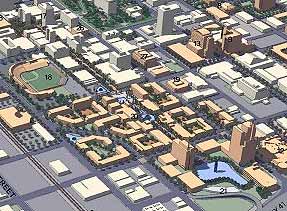
 FRESNO
- City Hall still has a sports stadia hysteria going in full bloom
this week. Mayor Patterson is moving to recoup a City Hall
deal with the Diamond Group tabled by the City Council recently.
But, Fresno taxpayers have an allergic reaction to public funding
of trivial pursuits and pastimes like publicly funded baseball.
There is good reason for caution. The economic impact of sports
stadiums has long term consequences.
FRESNO
- City Hall still has a sports stadia hysteria going in full bloom
this week. Mayor Patterson is moving to recoup a City Hall
deal with the Diamond Group tabled by the City Council recently.
But, Fresno taxpayers have an allergic reaction to public funding
of trivial pursuits and pastimes like publicly funded baseball.
There is good reason for caution. The economic impact of sports
stadiums has long term consequences.